
It’s no surprise that jewelry image editing comparison debates are constantly taking on new forms. In the 2026 visual industry, AI vs manual editing is under extreme gravity and that is increasing day by day. You can feel this weight even more deeply through a study finding from Technavio, a global market research company. They claim that-
AI denoise can provide more than 60% improvement in terms of how clear the content in the image will look in low light.
But, the point is- there is still 40% remaining open to question, right?
To stay ahead in the competition, you need to have a large library of ecommerce product photos ready, where you can’t compromise on quality. Whether you’re on Amazon, Shopify, or Etsy, this is true for visuals of every kind.
It turns out that speed and quality, you can’t go anywhere without either of them. And this is where a combined approach of both AI and manual comes in. How? Keep reading, one by one, every subtle point will become clear as daylight.
TL;DR:
The speed of AI + the flawless quality of manual editing; the combination of these two will set the stage for highly engaging product visuals that will significantly increase your ecommerce business ROI.
What is Manual Jewelry Image Editing?
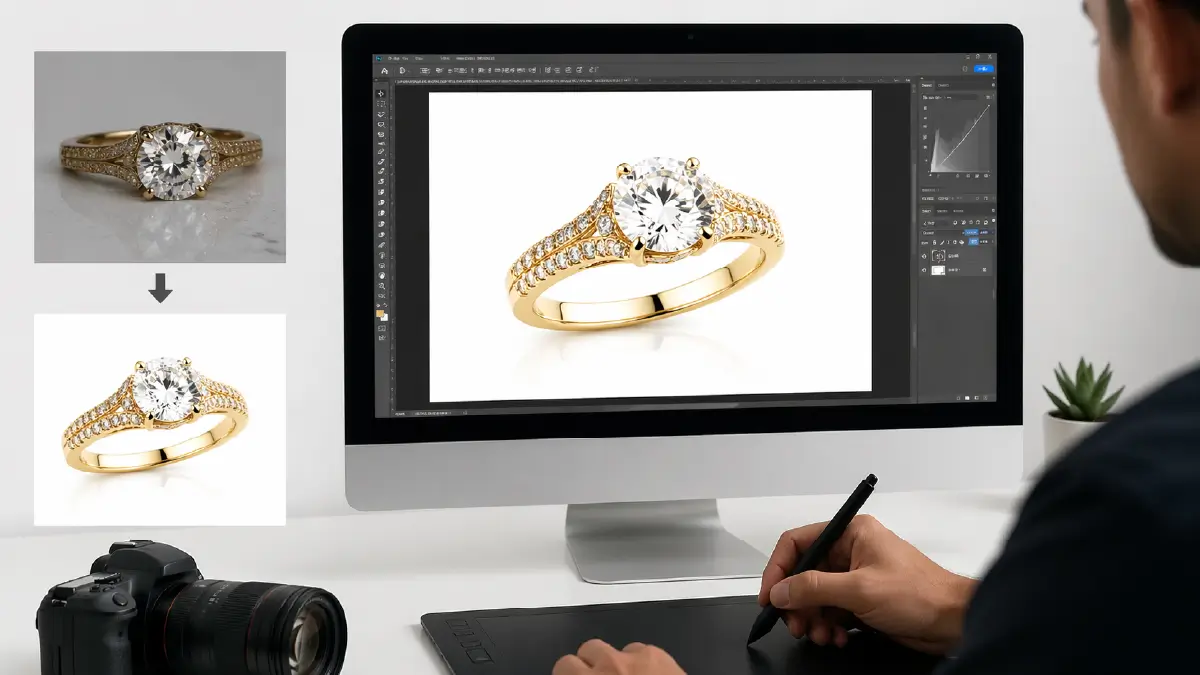
This traditional jewelry photo editing is a process where a human editor uses software to remove imperfections from an image by hand and make it presentable online. You won’t find the natural brilliance of precious stones even nearly anywhere else as much as you get with expertly hand-edited gem reflections.
You’re probably already familiar with various types of image editing software, but if asked to give an example, you’d probably think of Photoshop first, right? Moreover, Photoshop is so popular all over the world for jewelry editing that no other software can match it.
Not to mention its precision detailing chains. Just put it in the hands of a skilled retoucher, and you’d be hard-pressed to find any discernible difference between a real-life gemstone and its photo version.
What is AI Jewelry Image Editing?
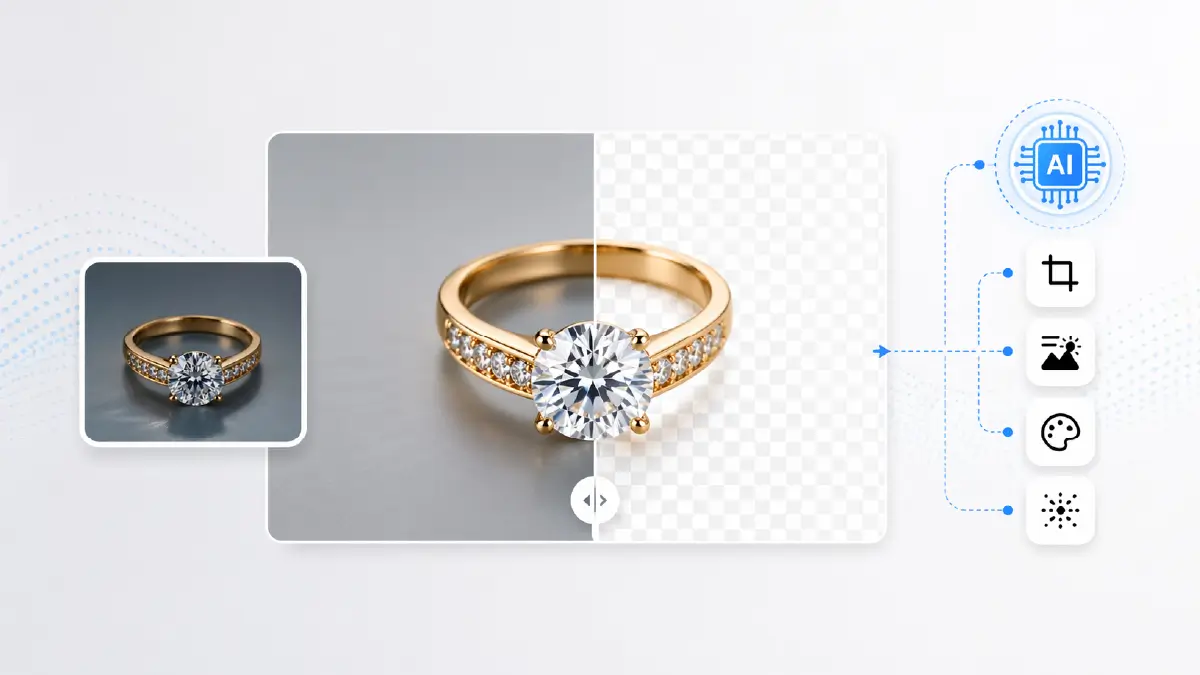
This is the latest trend in photo editing, where AI is used to fix and enhance photos. And this automated image enhancement is behind the scenes of fixing thousands of jewelry images in minutes.
Take AI background removal, for example, which is already one of the most popular services in the industry. This service, which can separate a product from its backdrop in seconds, is worth considering as a large-volume service.
Even more powerful are the AI batch processing gems, which can handle your entire online catalog. Neural network retouching will leave you even more impressed when you see how swiftly it adjusts lighting and color in the deepest parts of a photo.
Manual vs AI Jewelry Photo Editing: Head-to-Head Comparison
It’s a common practice that when preparing a budget, you don’t just look at costing. There’s also quality, time to complete the edits, and understanding how much human replacement is actually worth, especially in the case of AI services.
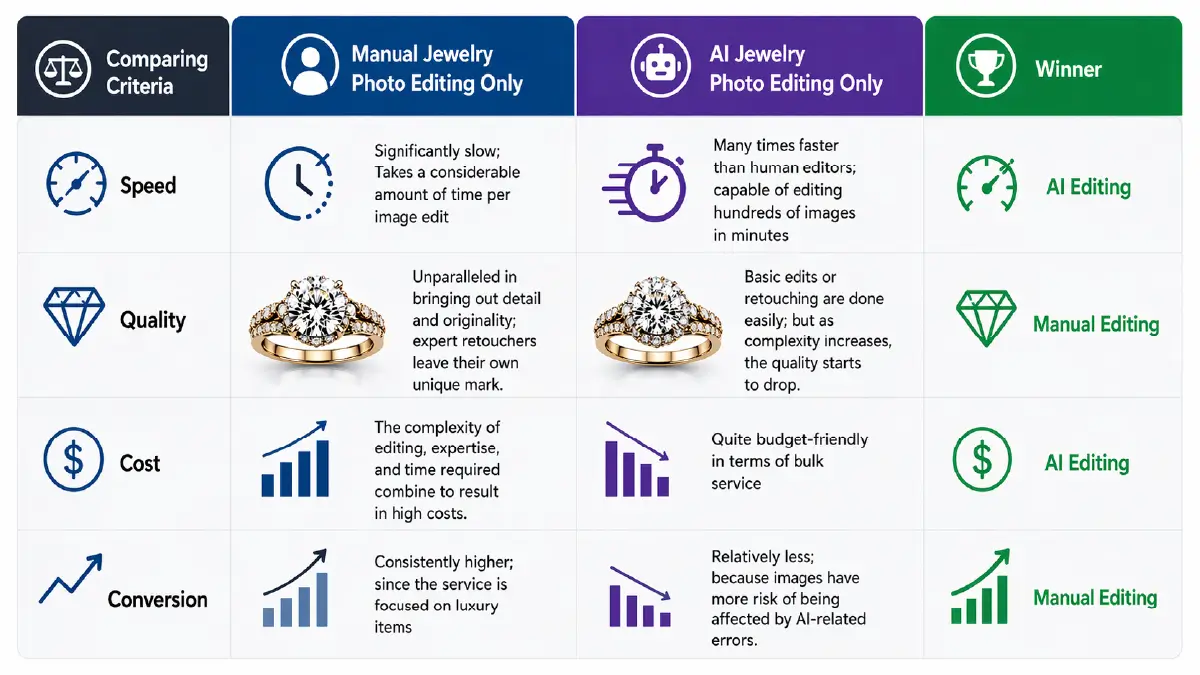
The chart below will give you a quick idea of these parameters.
| Comparing Criteria | Manual Jewelry Photo Editing Only | AI Jewelry Photo Editing Only | Winner |
| Speed | Significantly slower; takes a considerable amount of time per image edit | Much faster than human editors; can process hundreds of images in minutes | AI Editing |
| Quality | Unmatched for detail, realism, and precision; expert retouchers add a refined luxury finish | Works well for basic edits, but quality often drops as complexity increases | Manual Editing |
| Cost | Higher cost due to time, complexity, and expert skill requirements | More budget-friendly, especially for bulk editing | AI Editing |
| Conversion | Usually higher, since luxury product images demand precision and authenticity | Often lower due to AI inconsistencies and possible visual errors | Manual Editing |
AI vs Manual Jewelry Editing: Pros, Cons, and Best Use Cases
When you put the pros and cons of AI jewelry editing side by side with those of human retouching, it becomes clear to you why you need a hybrid workflow for your e-commerce business.
AI Jewelry Editing
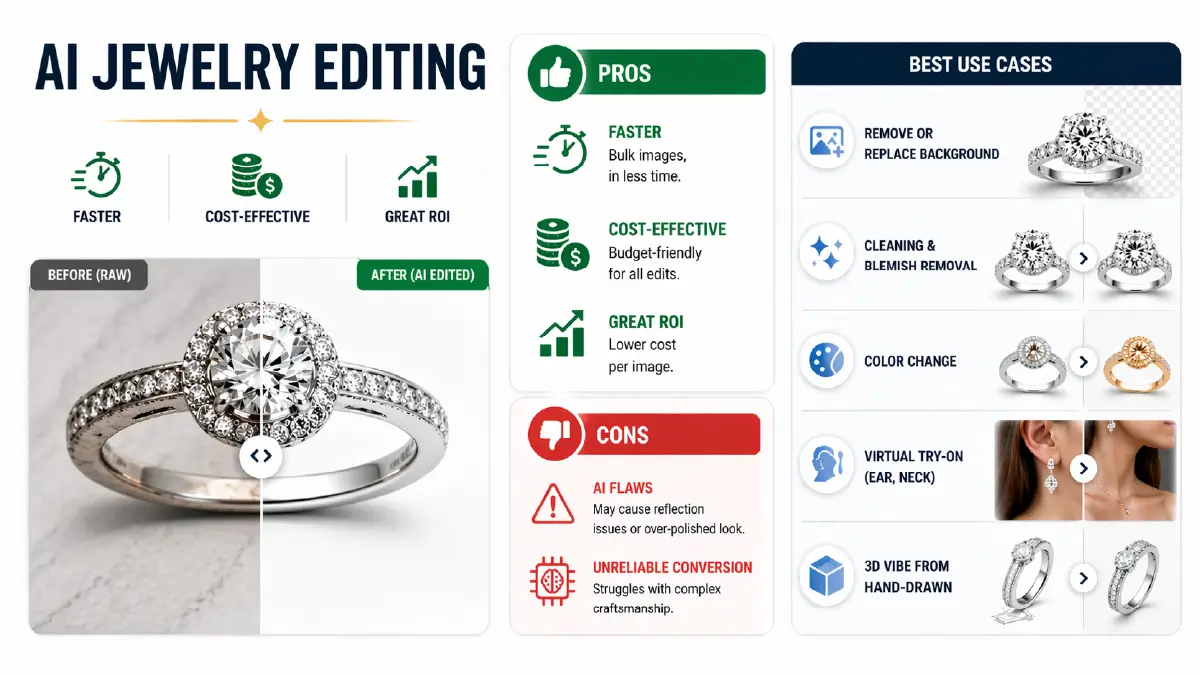
Here are the pros and cons of the AI part, listed for you to instantly screen out. Look and compare it to what you already have experience in the industry:
Pros
- Faster than ever before: AI is unmatched in delivering bulk jewelry images at a faster speed or in an unprecedentedly short time. That’s why you can rely on it for your volume catalog, or to launch your gemstones in no time.
- Highly cost-effective: From basic to complex retouching, AI services often beat the corresponding manual editing in terms of budget friendliness. It gets worthwhile with great ROI when you go large-scale, as the price per image comes down to a very nominal level.
Cons
- AI flaws: AI is often vulnerable to issues with light incidence and reflection, especially in natural light. You also have to take the risk of text distortion, an over-polished look that gives off an unrealistic look, like giving metal a plastic look or making it flat.
- Unreliable conversion: While it can produce incredible results on basic designs, you rarely see AI working well on jewelry with heavy craftsmanship. While some newer AI models are doing quite well on mediocre designs, they have yet to make a positive impact on gemstone conversions on a large scale.
Best Use Cases
- The following basic (mediocre to some extent) editing for thousands of images in a very short time:
- Remove or replace the background
- Primary surface cleaning and blemish removal
- Primary color change for the whole catalog
- Making an on-model (ear, neck) virtual try-on image from a simple piece of jewelry
- Giving a 3D vibe to a hand-drawn picture
Manual Jewelry Retouching
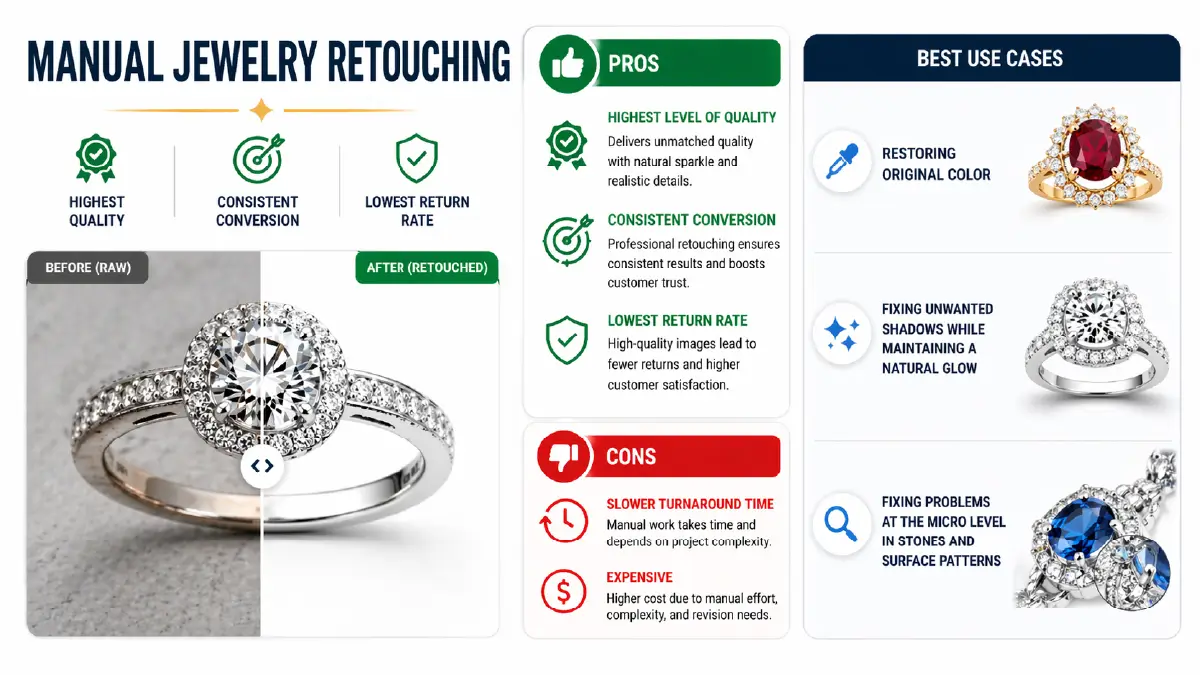
This section is about the advantages and disadvantages of human retouching. You can definitely relate to these because the practices have been around for a long time.
Pros
- Highest level of quality: Human editors can achieve unparalleled quality in fixing issues like merging multiple layers or paths, overlapping photos, and unrealistic shadows. And this is why you should go manual for diamond sparkle if you really want to get natural shine at any cost.
- Consistent conversion: Being a luxury item, the exceptional quality of its complex designs makes shoppers forget how much time is spent on retouching. So, while not very high, professional human retouching brings consistent conversions and, importantly, leaves product return rates at their lowest.
Cons
- Slower turnaround time: Since human effort is time-consuming, which usually varies depending on the type of work, it takes time to deliver.
- Expensive: The hourly rates for a significant number of photo retouchers, combined with the time required to complete the entire project, drive up the final cost. Adding complexity to the work has an upward impact on this costing, plus the need for revisions increases costs by lengthening the project time.
Best Use Cases
Ensuring premium quality by highlighting the following details in precious gemstones (gold, diamond, ruby, sapphire):
- Restoring original color
- Fixing unwanted shadows while maintaining a natural glow
- Fixing problems with stones placed on and patterns added in the surface at the micro level
Frequently Asked Questions about Manual and AI Jewelry Editing
1. Manual or AI jewelry editing, which delivers better quality for jewelry reflections and textures?
Skilled manual editing is always ahead of AI in ensuring quality. Professional human retouching is so effective that it makes complex reflections and detailed metallic textures look flawless and premium.
On the other hand, AI often over-smooths fine reflections and gives such a touch to the metallic properties of gemstones so that they look almost plastic.
2. How much time and cost does AI save vs manual editing?
For basic but fairly repetitive tasks like simple color correction and background removal, AI can reduce the cost of human expertise by up to 85%. And in this visual production, AI can reduce the time spent on manual work by up to 95%, meaning production speeds up.
3. Can AI handle complex jewelry like diamonds or chains accurately?
The short answer is no. AI makes a lot of effort to bring out the real subtle features of a diamond or chain, and the results are also good, but in most cases, they are not at all as expected. So you cannot rely on them without hesitation. In particular, you definitely do not want to see problems with your gemstones, such as their patterns becoming one or being over-polished.
4. Can I edit old photos with artificial intelligence?
Yes, you can. There are several types of AI tools that can restore old photos to a state close to their original state in most cases. The problem here is that if your original photo is of poor quality, such as heavily discolored, damaged, or torn, AI often fails to restore the image while maintaining proper quality.
5. Is manual editing still necessary for ecommerce listings?
Yes, it is equally important in this AI era as well. Because AI can handle primary and in some cases medium complexity tasks, but it fails to take care of the most complex tasks (design patterns, accurate colors, natural glow).
Especially for the ‘hero’ image of your jewelry, you will want to give it manual retouching even after giving it AI edits. Because while every other image in the listing is important, this image represents your listing from the front.
Final Verdict: Which Wins?
After a careful analysis of the above aspects, it can be frankly admitted that in 2026, you should go for a hybrid approach. Whether you choose AI or manual e-commerce, you will notice that there is a deficit in one or the other.
Fast, cost-effective AI poses the risk of complex design flaws and inconsistent conversions, while qualitative, high-converting manual methods pose long delays and a huge cost burden.
Proceed with conversion-boosting photo editing in each case, and along the way, you can understand by yourself exactly where you need to make adjustments. Thus, through the combined use of AI and manual retouching, you can expect to ultimately increase the ROI of jewelry visuals.