

51% of shoppers are ready to change the entire marketplace if they get a better-understood image.
It was the surprising finding of research conducted by Photoroom’s State of GenAI in 2026. And yes, marketplaces are this much competitive these days. You can see how compelling the pull of finding an e-commerce photo editing service partner is.
Just when you’re counting how much hours and pennies it will take to edit your vast collection of photos, your target audience is turning their backs on the platform where you do business.
Still, you can’t risk just randomly outsourcing image editing. Can you, when the future of your digital store depends on this investment?
Don’t worry, here’s a very easy-to-follow guide, where you’ll find the right strategies you need to adopt this 2026, and you don’t have to play a blind game when hiring photo editing services.
TL;DR:
Listing and then picking the cheapest one! This isn’t the way to win the game of choosing the best ecommerce photo editing service in 2026. You need to get the one that will give you quality retouching while protecting your visual assets and balancing your budget and deadline. Find the checklist of things to do before outsourcing inside!
Match Your Needs: Volume, Turnaround, and Complexity
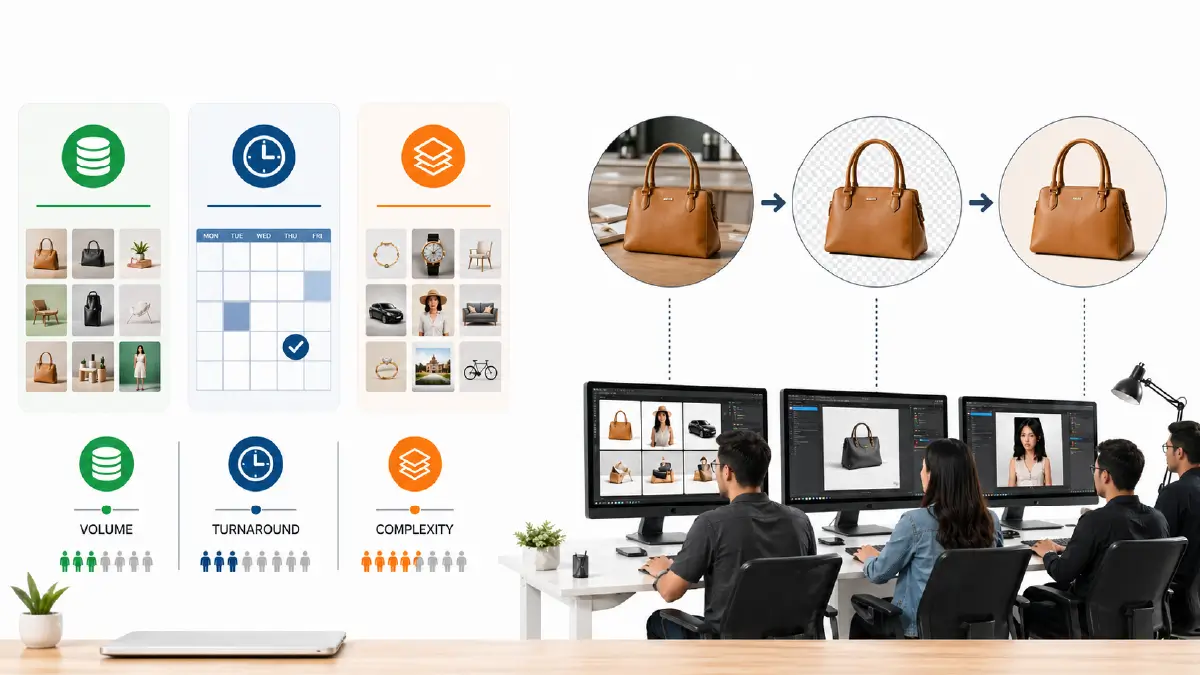
First, you need to decide – how many, in what timeframe, and how much. For example, in terms of volume and complexity, you should look for batch image processing specialists who don’t skimp on detail in the images.
When you’re stuck with a tight deadline, you’ll definitely want to go with a larger team of service providers, as deep and detailed quality work requires more skilled graphic designers.
If possible, be a little flexible with your timing, because the more time is given to your raw images, the better results you’ll get back. Of course, their image editing workflow needs to be consistent.
Check Quality, Consistency, and Editing Standards
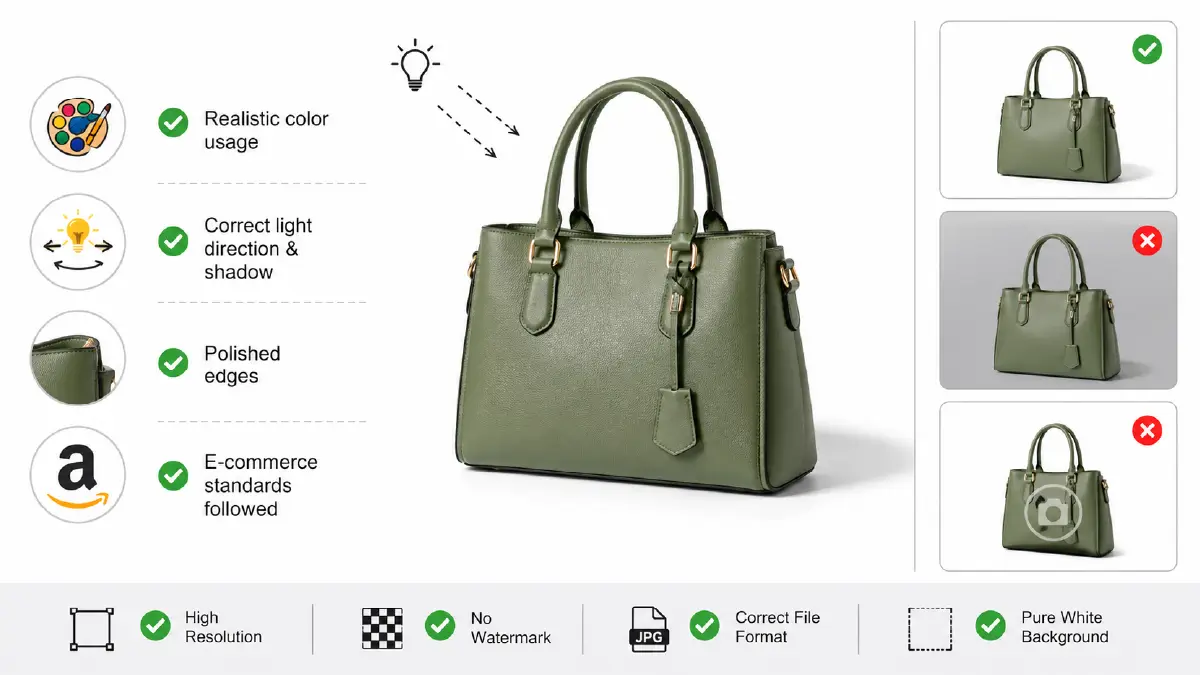
How can you check how much quality work they do? Go to their website and see their past work. You can catch the following things even without being skilled in image editing:
- How realistic the use of colors is on the product
- From which direction does the light fall on the product and which direction does its shadow fall
- How polished are the edges of the product
In addition to the above, pay attention to whether they follow the image guidelines of the e-commerce platform. Let’s say your target platform is Amazon. Then you will definitely find out whether they strictly follow Amazon’s requirements regarding resolution, watermark, and image file format, including white backgrounds.
Compare Pricing Models: Per Image vs Bulk vs Subscription
Once you have determined your needs, you will know which pricing model you should go for – per image, bulk or subscription. Keep in mind that there is no such thing as a perfect model in every way. Whichever one you choose, you will have to compromise on one or the other.
The table below will give you a clear idea of which model you should go for in which situation by pinpointing the features of the models.
Table: Difference between Per Image, Bulk, and Subscription pricing models
| Comparison criteria | Per Image/ Pay-as-you-go | Bulk | Subscription |
| Expense | Highest cost per image | More than per image model but less than subscription model | Lowest cost per image for bigger packs |
| Time boundness | Instant buy | No quotas to reach within a designated time | Quotas to reach within a month |
| Commitment you get | Pay as you go; no commitment | Different bulk packs can be paid at once/multiple installments | Several subscription plans recurred monthly |
| Incentives apart from core services | Almost none | Mainly reducing the price per unit of the core service | Many incentives like
|
| Flexibility of upgrade or downgrade | Zero chance to modify | You can upgrade or downgrade | You can upgrade or downgrade |
| When to choose | For a small amount | For occasional needs | For a steady supply every month |
Security, NDAs, and Data Protection for Product Images
Your images are your assets, so you need to be on the lookout for them at all costs. Check that service providers have a protocol in place to sign a non-disclosure agreement for your assets.
You can do a basic check by visiting their privacy page at the very beginning. Further, check if the service providers have a protocol for signing a non-disclosure agreement for this asset of yours.
Verify the methods of how they take your image files and how they give them to you after the work is done. To maintain such security, professionals usually use methods like secure cloud storage and encrypted file transfer.
What Does a Top Ecommerce Photo Editing Service Include?
Photo editing is a vast area that includes a variety of techniques to make your products presentable to viewers on e-commerce sites. While doing your research, try to find the following solutions on the service provider’s website:
- Clipping Paths: This is a method by which an object is cut out from an image. Its most important application is to make the background transparent, change or whiten, which is the first requirement for displaying images on various marketplaces, including Amazon.
- Photo Retouching: Removes various types of distractions, such as unwanted spots, scratches, and blemishes on and around the product in the image. This is essential for making the image look clean in today’s deep zoom-in and 360-degree displays.
- Color Correction: Takes care of all color-related issues, including white balance, contrast, saturation, and color restoration. Matching the color of the delivered product to the color displayed in the digital store reduces product returns.
- Shadow Creation: Allows editors to adjust the direction of the shadow against the light incident on the product image and add new shadows to enhance the realism of the image.
- Ghost Mannequin Effect: This technique, applied in the fashion industry, especially in clothing products, makes the structure of the product easier to understand by removing the model associated with the product.
AI vs Manual Ecommerce Image Editing in 2026
AI tools are now the talk of the world for editing images in a very short time. But speed is not the only thing; at the end of the day, quality brings results. Take a look at the following chart, you will understand what kind of approach you should actually go for:
| Key Factor | AI Editing | Manual Editing |
| Quality | Good for basic editing, but often fails to deliver quality results for complex retouching. | You can get real and detailed results from expert editors. |
| Turnaround Time | It is so much faster than human editors that it can edit and deliver hundreds of images in minutes. | It takes a considerable amount of time from receiving instructions to delivery, which is much slower than AI. |
| Costing | Very cost-efficient, regardless of the different service plans with various complexities | Much higher, which increases even more based on time, expertise, and complexity. |
| ROI | Significantly lower due to AI-induced errors | Professional retouching can lead to higher conversions. |
The chart above clearly states that AI and human photo editing each have their pros and cons, and are surprisingly complementary. If you prioritize quality, you’ll fall behind on speed, and if investment is your real concern, know that the cheaper option will ultimately hurt ROI.
AI-human Hybrid Approach is the Answer
What can save you from this dilemma is to go for a hybrid approach that combines both, rather than going for either AI or manual.
For example, you will be amazed to see how Topaz Photo AI cleans up images at the primary level, as well as sharpening and removing noise. And you will get Luminar Neo to take care of creating your ghost mannequin.
Thus, you can complete a baseline of your image batch with these AI tools and then hand it over to pro retouchers. Watch how they turn AI artifacts into perfect gems with Adobe Photoshop or Lightroom.
The advanced tools inside the software instantly bring out the real texture, shadows and colors of the product at their fingertips.
How to Shortlist Ecommerce Photo Editing Providers
Now it is time to get hands-on experience. Start going on trial of their services. Mark whether they are doing exactly what they say. At this time, you will get, buy product, a clear idea about their communication skills, care and dedication towards the job.
After the trial is over, make a shortlist based on the experience gained. Tick the ones who have clearly followed every claim they have made. Then move the ones who are maintaining the highest quality up.
Finally, bring forward the ones who are in the best balance according to your budget and timeline. And through this, you filter out the best ones to negotiate for your project.
Frequently Asked Questions about Choosing an E-commerce Photo Editing Service
1. What is the key difference between bulk and subscription pricing model?
In the bulk model, pricing is basically set for images at a volume level where the cost per image is greatly reduced. There is no time limit for project pricing, just the total pricing is fixed against the large number of images.
Subscription model, on the other hand, has a fixed price set against a certain number of image quotas, which are consistently recurring each month.
2. What should I ask before hiring an ecommerce product image editing service?
When choosing an image editing partner, the very question you should ask is – How will you bring out the details and nuances of my images? Firmly stand on the “how” and try to clearly know whether they are actually capable of meeting your needs. Because when they go to expand this “how”, their experience, team size, adopted techniques, working style, etc., will come.
3. Is it safe to outsource ecommerce product photo editing?
It really depends on who you are outsourcing to. If they respect the ownership of your image files and don’t use them in any marketing campaign or sell them, then they are safe for outsourcing. They should use secure means (like secure cloud storage or encrypted file transfer) to receive them from you and deliver them to you after final editing.
4. Can AI replace human photo editors in 2026?
It depends on whether AI tools for photo editing will be able to produce results with absolutely flawless quality by 2026, without the need for any human intervention. The extent to which AI is being used across the industry so far is a clear indication that it is not yet there.
Of course, in the case of very basic editing and retouching, it is now seen that in most cases, there is no need to rely on humans. But for medium and complex tasks, AI is far from reliable. Therefore, human retouchers are still needed to make the necessary editing and decisions after verifying the reality, subtlety, and detail.
5. How to test an image editing service with a sample batch?
First, prepare 15-20 sample images and send them to the editing company. Don’t keep all the images the same, but keep them different, such as backgrounds with different clutter, messy light and shadow, wrong colors, distorted text, etc. Along with that, be sure to give clear instructions (what the background will be like, whether there will be shadows, file format, etc.).
Be careful about the medium through which you send them the images. Then, when you receive them, count the turnaround time. Then check the quality according to the instructions you provided.
Final Words
That’s all for how to choose the best ecommerce photo editing service provider in 2026, which you start by pinning down your needs. Then look at the retouchers’ handiwork, their personality, and how close they are to market standards.
Don’t filter out companies based on the cheapest option in the pricing section, but rather balance their skills, experience, deadlines, safety, and professionalism with your needs. Look for techniques like clipping paths, photo retouching, color correction, shadow creation, and the ghost mannequin effect.
Instead of going with the flow and focusing solely on AI editing, opt for a hybrid method of AI and manual editing. Combinedly, these research steps will help you shortlist the best ecommerce image editing service providers.