
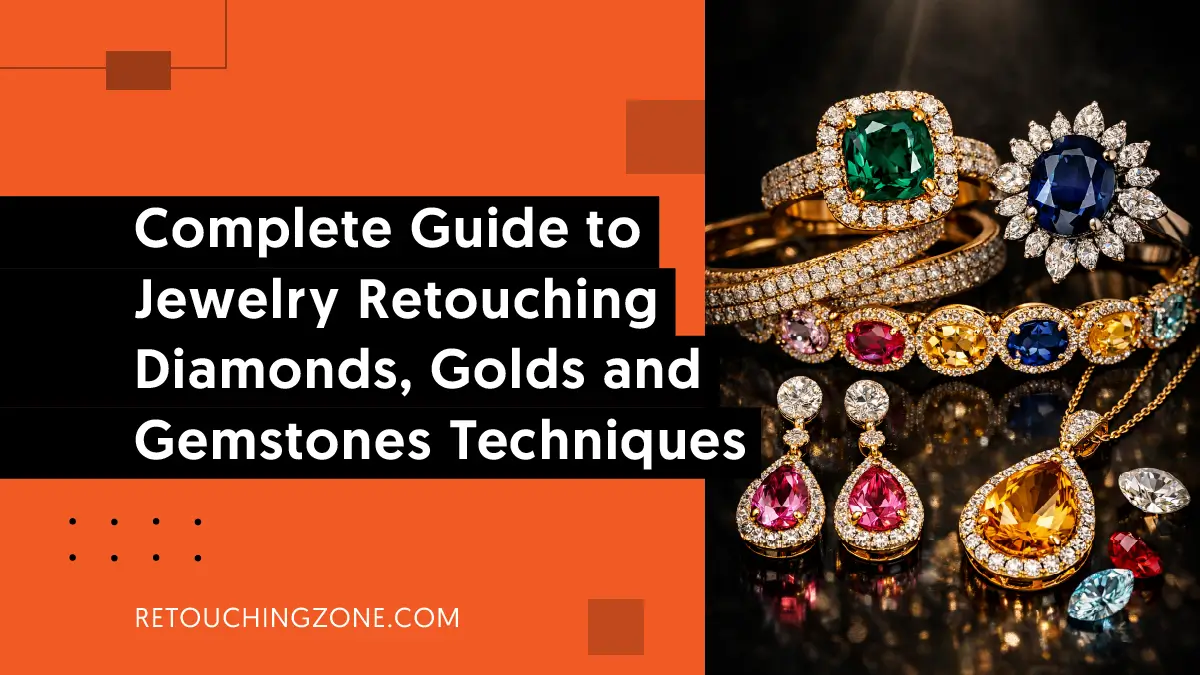
The design changes in diamonds, golds, and gemstones loudly tell how promising it is to show trending jewelry styles through images. This is where you find jewelry retouching as the most up-to-date activity that has evolved into its current form due to the demands of necessity.
But the thing is, how can you keep up with this growth for your ornaments e-commerce store? Are there any AI tools to get results on a large scale in less time?
This complete guide to jewelry retouching is going to discuss the answers to these questions in detail, which will help you auto-pilot the process of converting your visitors into buyers effortlessly.
Key Takeaways
- Retouching techniques include color adjustment, clipping paths, and shadow creation to bring out the external and internal characteristics of lab-made jewelry in the image.
- For interactive experiences like digital twins, you can use AI to do bulk-level retouching, but it definitely requires a human touch to make them artistic and flawless.
| Jewelry Retouching Techniques | Results of the Technique |
| Background removal, Clipping paths, Shadow creation | Sharp and precise structure |
| Digital Black Card | Jewelry reflection |
| HDR highlight recovery | Remove the gray plastic look of silver and bring out the true brilliance |
| Frequency separation | Remove color spots on layers for Florentine or Hammered texture |
| Enhancing the facet joints | Avoid black hole lens reflections in lab-grown diamonds |
| Curves Layers and Selective Color Adjustments | Better red hue; develop three-dimensional look |
Attention to Detail for the Jewelry Structure
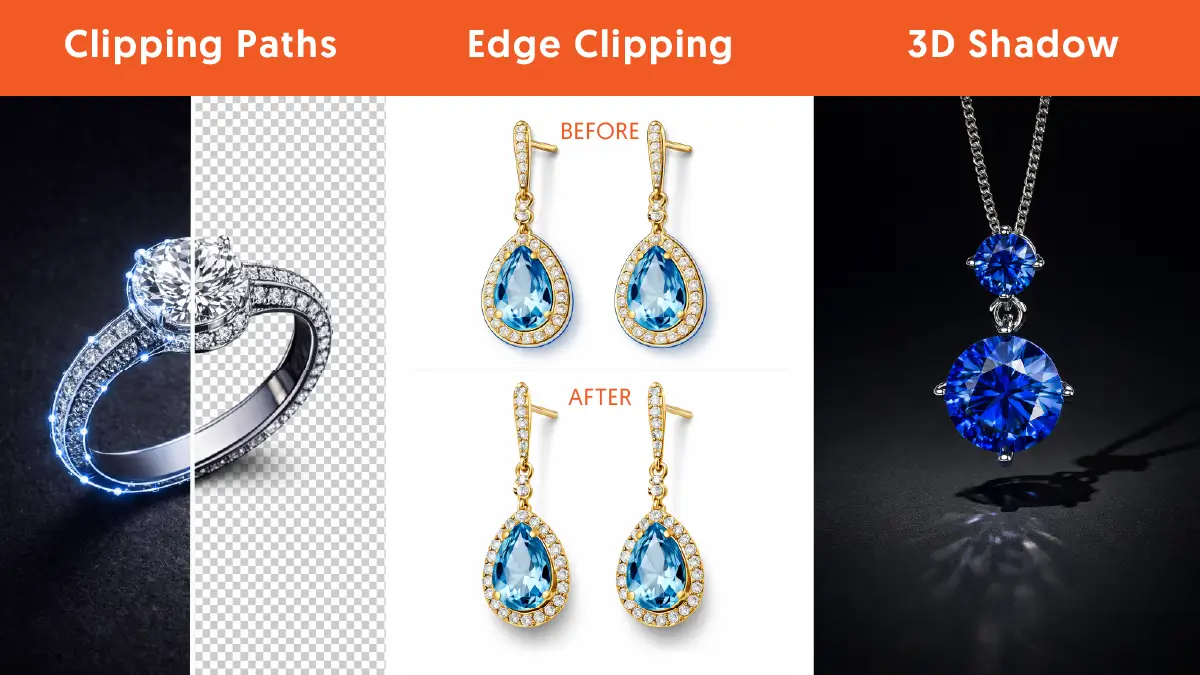
You get jewelry to live on its structure, which also affects its regalness. The more you are able to capture this design depth (sharpness and precision) in your photos, the more conversion-oriented the jewels will be.
This crisp look comes out best when you remove the background of the product photo. For very complex silhouettes, you can use the following methods for this photo editing:
- Clipping paths with the pen tool
- Edge clipping to remove color bleed
- Shadow creation to maintain the 3D look
Jewelry Retouching for Characteristic Clarity
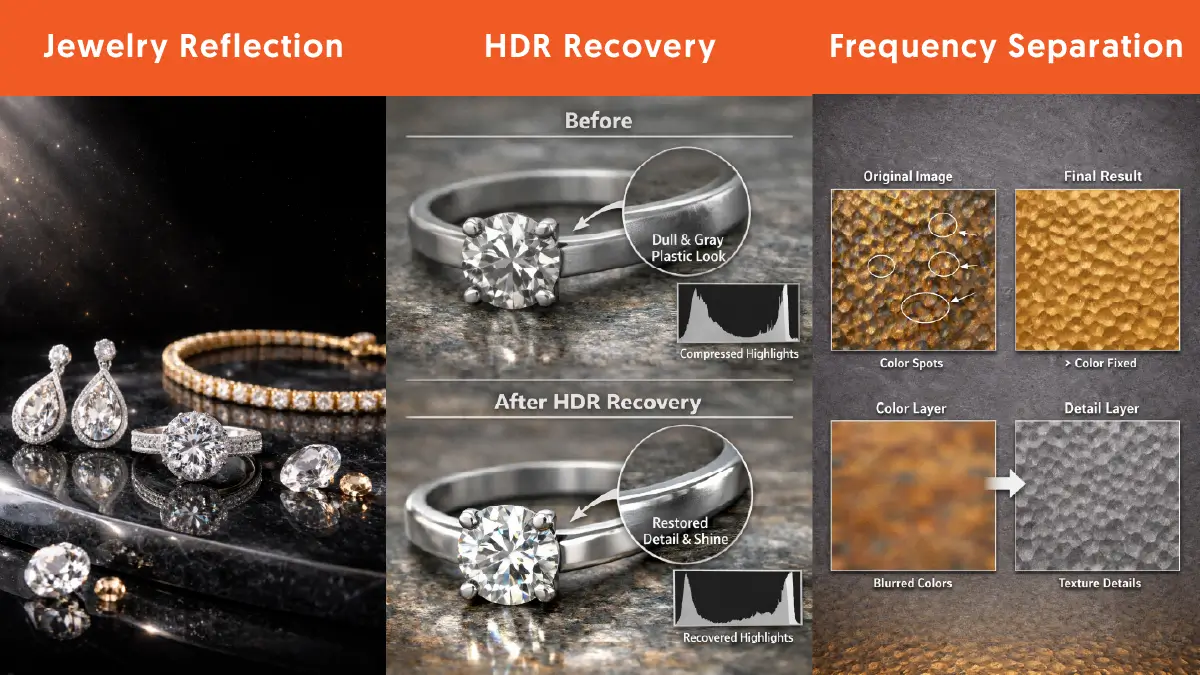
Whether your jewelry is diamond, gold, or gemstone, your jewelry photos must speak volumes about its visual characteristics. Some of the retouchings you can use for blooming different types of characteristics are-
- Digital Black Card on the shiny, smooth stone surface for jewelry reflection
- HDR highlight recovery process to remove the gray plastic look of silver and bring out the true brilliance
- Frequency separation to remove color spots on layers for Florentine or Hammered texture
Retouching for Lab-Grown Diamonds and Special Gemstones
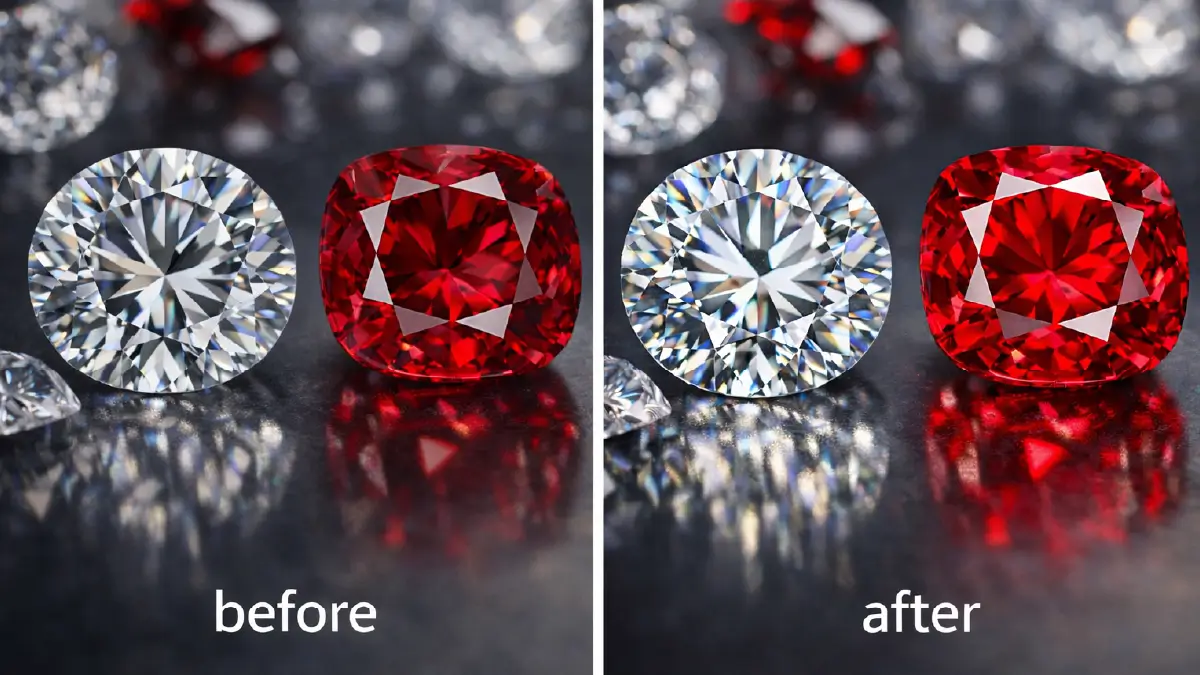
You are probably aware of the current trend of lab-grown diamonds, and Mozambique and ruby garnets. These need urgent retouching; in particular, you should focus on enhancing the facet joints, which helps to avoid black hole lens reflections.
With rubies and Mozambique garnets, you may have to struggle to get the saturation right without clipping. With Curves Layers and Selective Color Adjustments, you can create a better red hue; this will preserve the light inside your gemstone and give you three-dimensional detail.
Maintaining Originality Without Any Compromise
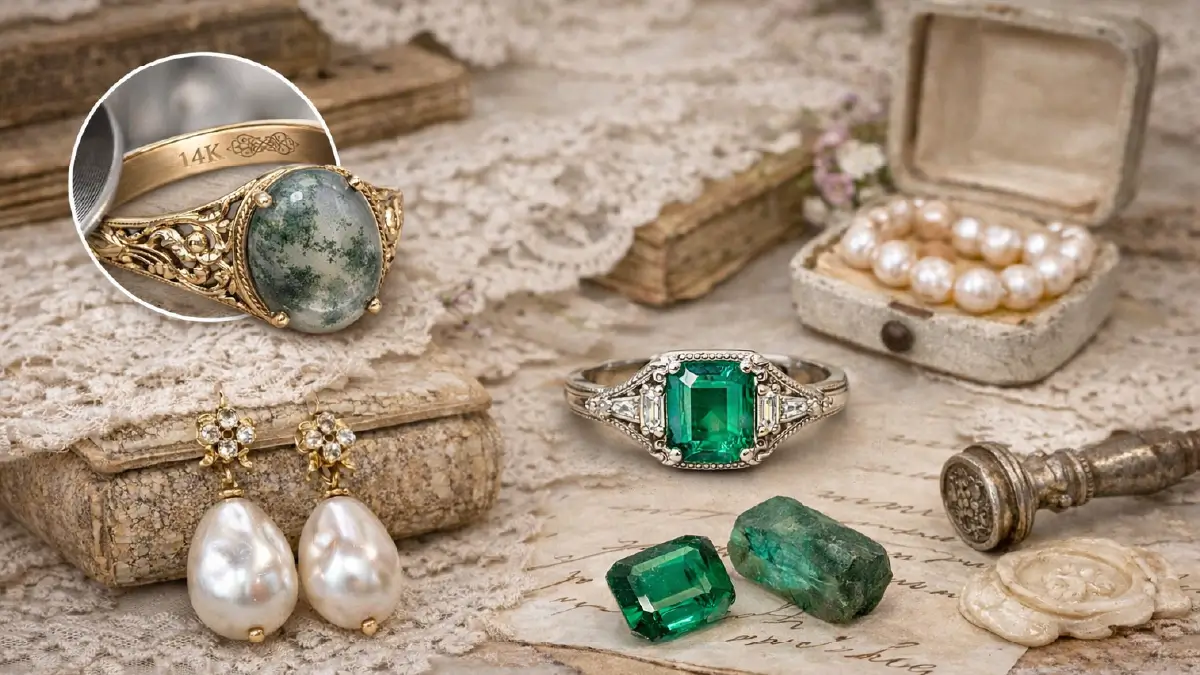
In 2026, it is undeniable that jewelry buyers now value the artistic value and heritage of jewelry. You have probably noticed how the “Taylor Swift effect” vintage style works great against a high-contrast look. In this case, a soft color palette will be best for you.
Thinking about gemstones like moss agate or baroque pearls, since they are quite sensitive? Here are some ways to improve in these cases:
- Look for laser engraving highlights and hallmarks as evidence for greater depth and detail.
- Maintain the highest level of naturalness in the design features of the emerald by all means.
Doing Automation and AI Right
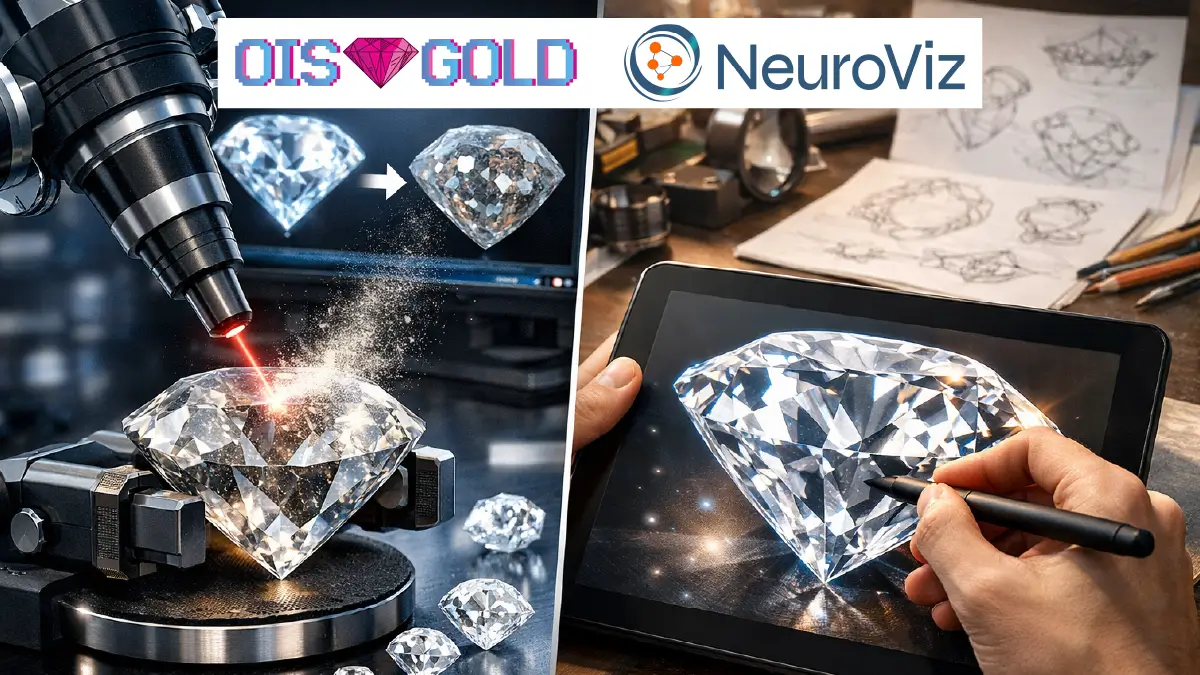
You must understand that you are now living in an era where thousands of imperfections are being removed from precious stones in seconds; that too with a single scratch.
For this, you can rely on either OIS.GOLD or NeuroViz, as both tools do not leave any anomalies behind in the texture while removing dust. This amazing application of neural networks cuts down on your hours of work.
However, for the proper practice of creativity, you must not just sit and let AI do the whole work. You also need your own perspective to breathe life into the artwork.
Applying Future-Ready Visual Techniques
In 2026, shortening the distance between product search and checkout for your customers very much depends on how interactive their store browsing experience is.
Thinking of replicating the refractive index of sapphire? Use Blender Shading Nodes to create procedural textures, better known as the “digital twin” method. This is a technique where you can make your audience feel the weight and size of jewelry as if they were physically testing it.
You’ll be even more excited to know that there’s a great AI tool called Claid.ai that can help you create this enhanced experience for your audience.
Frequently Asked Questions about Jewelry Retouching Techniques
1. What jewelry retouching techniques enhance the structural visuals of diamonds, golds, and gemstones?
Clipping paths (precisely background removal), shadow creation, and color adjustment are jewelry retouching techniques that enhance the textural visuals of precious stones.
2. How can I remove the gray plastic look of silver and bring out its true nature?
This is the HDR highlight recovery process through which you can correct silver’s visual and give it its true brilliance.
3. How can I avoid black hole lens reflections in lab-grown diamonds?
To solve this problem, you need to specifically enhance the facet joints of the diamonds.
4. What is the Taylor Swift Effect?
In her jewelry campaigns, popular American singer Taylor Swift chooses to showcase old-mined diamonds with its natural imperfections intact in soft-lit ambient. This is the only vintage and minimalist style that became popular solely for the singer, hence the name Taylor Swift Effect.
5. What is the best AI tool for developing the digital twin experience for your Jewelry eCommerce stores?
Claid.ai is the AI tool that can be your best choice to create the digital twin experience for your jewelry products.
Final Words
This guide to jewelry retouching states that your diamonds, gold, and gemstone visuals should be enriched with their originality. Look for signs like lens engraving and hallmarks for verification, but will not remove actual flaws during editing.
Since the trend is for lab-grown diamonds, pay more attention to improving facet joints. Clipping paths and shadow creation, along with color adjustments, are your major retouching techniques.
Last but not least, you can go for leveraging AI at the volume scale to create the digital twin experience, and that is not invalid at all, just don’t forget to give it human touches.