
The composable commerce vs headless ecommerce debate rages on, inevitably, when you want to accelerate your ecommerce business for the long haul in a technologically progressive market.
In fact, it’s 2026; everyone is breaking out of the one-stop solution of traditional monolithic ecommerce. So, why do you want to be satisfied with just one business software? Needless to say, the online business is no longer what it used to be.
Let’s dive into a detailed comparative discussion of which one, between composable and headless, will be the right decision to build and maintain your online store.
TL;DR:
- Composable commerce is a modular approach that independently organizes ecommerce business technology stacks to improve the customer experience without relying on technology service providers.
- Headless eCommerce is a foundational technology that separates the frontend and backend of an eCommerce website and manages them independently to perform various business functions.
- As a starter, you should go for headless first and then gradually adopt composable ecommerce over time.
Composable Commerce vs Headless Ecommerce: A Quick Comparison
| Metric | Composable Commerce | Headless Ecommerce |
| Approach | Modular system with a large ecosystem of ecommerce components | A key architectural component used within composable commerce |
| Insight | Framework for organizing multiple business capabilities | A specific ecommerce technology approach |
| Integration Constraints | Independent modules allow flexible integration of ecommerce solutions | Still relies on backend systems for core ecommerce operations |
| Initial Investment | Higher initial investment but more scalable long term | Lower initial cost but may become expensive with scaling |
| Component Integration Flexibility | Flexible plug-and-play architecture that saves development time | More complex integrations requiring custom development |
The table above should be enough to jumpstart you. Because it crafts some straightforward answers to the question: what are the key distinctions between composable and headless ecommerce?
Headless ecommerce is an integral part of the vast compsable commerce ecosystem. The prerequisite for moving to a composable system is to adopt a headless architecture.
There are also headless systems that are not fully “composable”. However, you cannot enter a composable commerce ecosystem without fundamentally adopting a headless architecture.
If you are still on the fence, rejoice that now we will dive very deep, where you will get a thorough understanding; they won’t just be buzzwords to you.
What is Composable Commerce
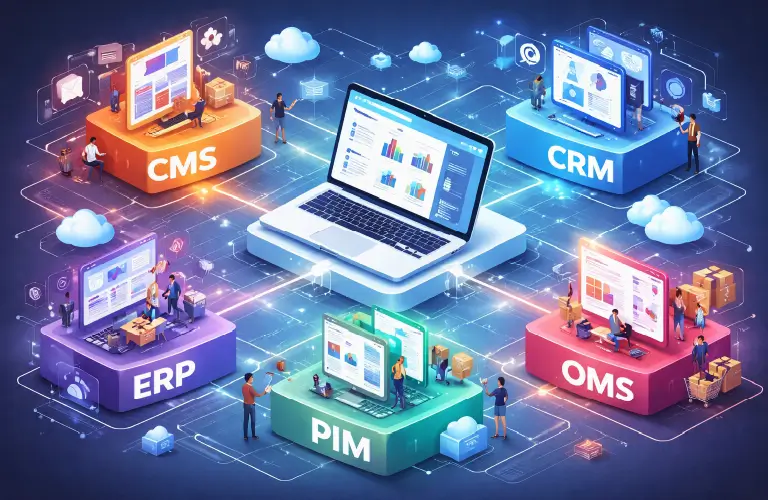
Also known as modular commerce, composable commerce creates a comprehensive business environment where different types of business software are integrated. The objective is to provide the highest level of customer experience.
If you want to better understand the composable commerce architecture, you want to be familiar with the term- Packaged Business Capabilities (PBCs). It is nothing but a digital form of different types of business, against which you will find composable commerce examples.
Popular PBCs are:
- Content Management System (CMS)
- Customer Relationship Management (CRM)
- Enterprise Resource Planning (ERP)
- Product Information Management (PIM)
- Order Management (OMS)
- E-Commerce Platform
To integrate these business solutions, modular commerce uses tech stacks like microservices, APIs, cloud, and headless, which in short are called MACH. There is also another approach named JAMstack, which refers to JavaScript, APIs, and Markup.
What is Headless Ecommerce
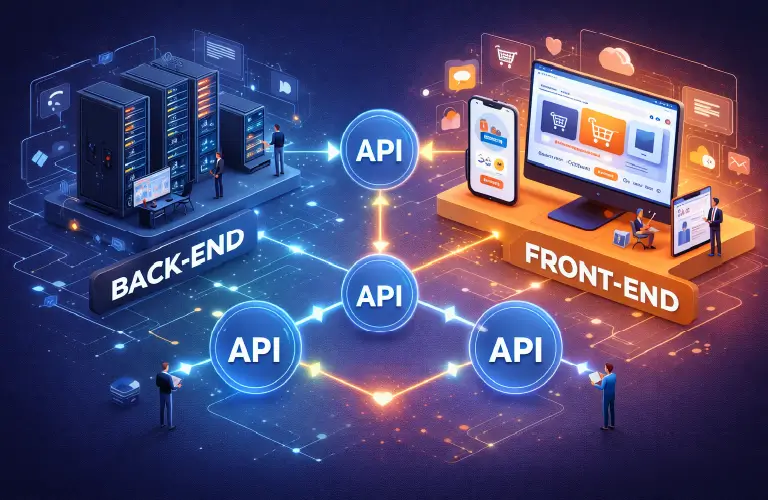
You already know that the back-end of a website is considered as its body and the head is its front-end part. Headless Commerce makes the frontend completely independent from the back-end of your site, hence the name “headless”.
Now you must be questioning what is seen in the front-end is the result of functions developed in the back-end. Then how is it possible when both of ends are decoupled?
Yes, this is exactly where APIs (Application Programming Interface) come into play to make a communication bridge between them, and that makes a headless architecture whole.
You must have heard about buying subscriptions through “Buy Now” button, buying products from ecommerce stores through mobile apps, and customer portals for self service.
All these are headless ecommerce examples, where different types of relevant PBSs are connected to the site primarily through APIs.
Pros and Cons of Composable Commerce
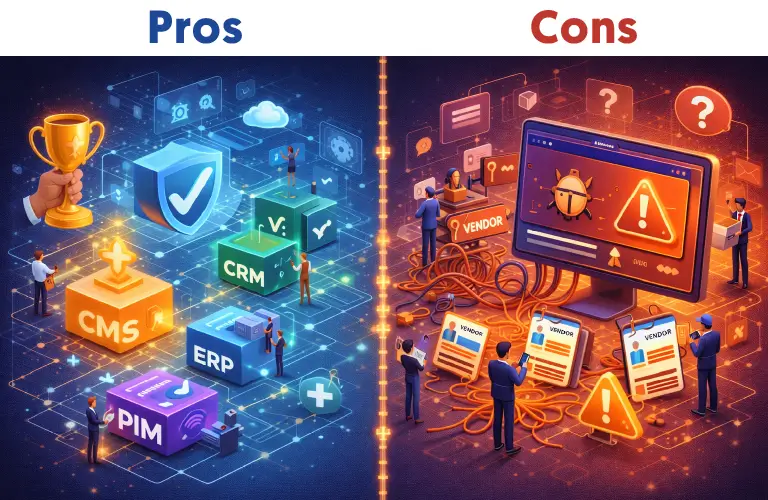
When the basic understanding hits the stage, you know that Modular Commerce brings you the complete digital business package. Let’s break down what the Composable Commerce benefits and drawbacks are.
Pros
- Ability to Integrate the best: It allows integration of the best software in the business domain, even off-the-shelf software bundles. Hence, this approach is popularly known as “Best-of-Breed Commerce”.
- Freedom of customization: There is no question of being satisfied with what a platform like Monolithic System provides. You can independently decide exactly which features you want to take.
- Cost by feature: At the same time, the choice of technology vendors is also in your hands. It only costs you to add a specific feature, not the entire platform.
- Change resilient: It is developed on a headless architecture, so adding new components does not affect the rest of its infrastructure in any way.
Cons
As you continue to add features as needed, this naturally involves handling multiple vendors. Not that you have to rely on stack providers to operate the features. The main problem will be when there is a technical error (especially in the back-end) and you have to contact the respective vendors.
Pros and Cons of Headless Ecommerce
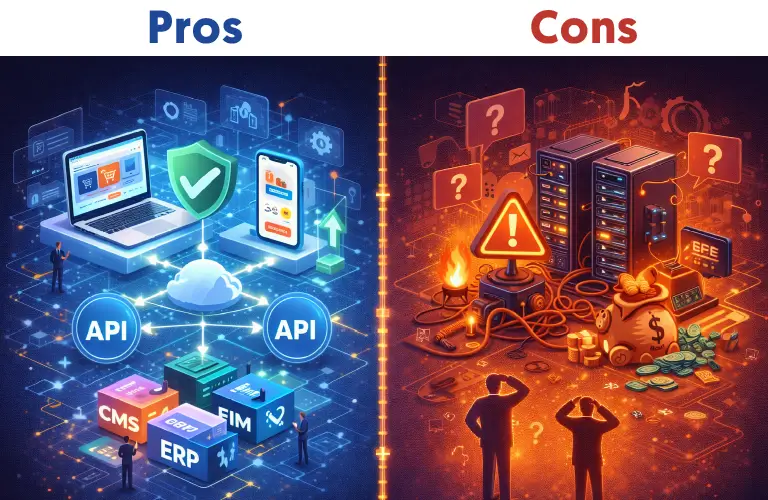
Being the trendy and forward looking technology of today, everyone is getting considerable advantage by adopting headless ecommerce. But you should not avoid its drawbacks before making a final decision. Let’s take a look at its pros and cons.
Pros
- No need to reinstall: Since the back-end and front-end are decoupled, there is no need to redeploy the entire architecture when there is a need for change or innovation.
- Safe upgrades: Updates are small and independent, so problems with one tool don’t affect the others.
- Back-end Maintenance Automation: Previously, the headless architecture required considerable expertise and time to solve technical problems at the back-end. But now, specially layer editing through AI and low-code-no-code connection hubs have largely eliminated manual hassles.
Cons
- Budget blowing probability: Accordingly, platform renewal and maintenance costs can pile up over time. However, the upfront cost of headless platforms is also quite high.
Best Ecommerce Platforms That Feature Both Solutions

You’ve probably realized by now that an important aspect of the composable commerce vs headless ecommerce discussion is managing a large technology stack together. When the nitty gritty of the back-end is there, the complexities naturally become louder.
You will feel relieved to know that the best composable commerce platforms are there to take away this worry. Most interestingly, they also cover the best headless ecommerce solutions at the same time, as for the record, the two are not contradictory at all.
Some of the most renowned ecommerce platforms are:
- Commerce Components by Shopify
- BetterCommerce
- CommerceTools
- BigCommerce
- Salesforce
Best Composable and Headless Ecommerce Solutions Providers
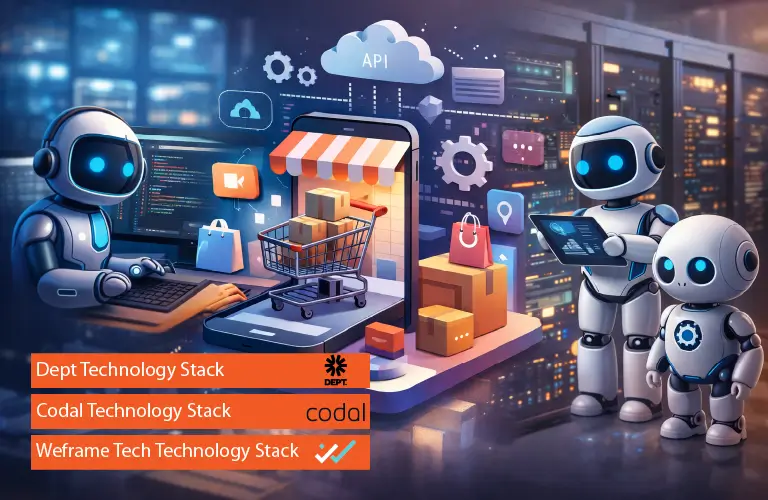
Two things come up when the actual work is integration:
- One- to be an expert in all technical management, including that integration
- Two- get someone skilled to do the integrations as well as the maintenance
You might be wondering about then which companies specialize in composable commerce platforms?
The good thing is that there are already several reputable service providers in the market who have been doing exactly this for a long time.
Some of the Best Ecommerce Solutions Providers are as follows:
- Dept Agency
- Codal
- Weframe Tech
Real World Examples of Composable and Headless Ecommerce
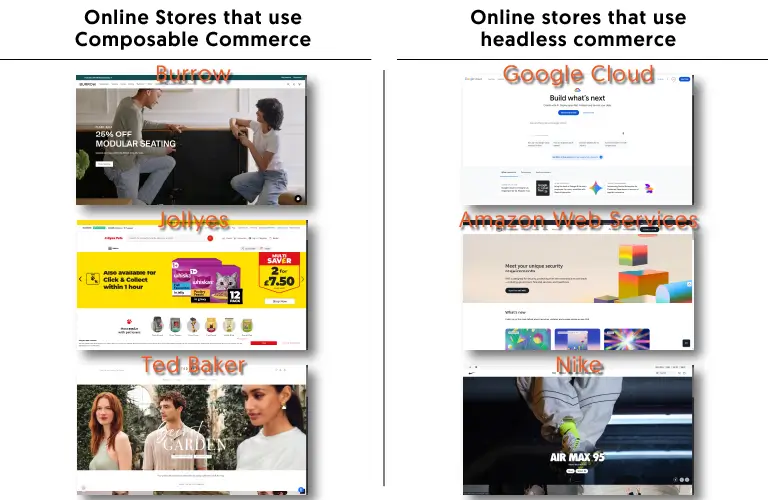
Now, let’s see some digital businesses that have taken their user experience to ultimate levels by adopting composable and headless ecommerce platforms. Through these, you will also get a quick scenario of what your online store should actually look like.
| Online stores that use composable commerce | Online stores that use headless commerce |
| Burrow | Google Cloud |
| Jollyes | Amazon Web Services |
| Ted Baker | Nike |
Frequently Asked Questions for Composable Commerce vs Headless Ecommerce
-
What is an example of composable commerce?
As examples of composable commerce, you can see: Shopify for CRM usage, BigCommerce for drag and drop visual editor, and even Stripe for payment gateway usage.
-
Composable commerce vs headless ecommerce: Can I adopt both for my online store?
In fact, headless is the foundation of Composable, so using headless is also using Composable in a sense. As a starter, use headless first and then gradually shift to Composable as needed.
-
What are the main differences between composable commerce and headless ecommerce?
Composable commerce leverages modular, best-of-breed components that can be freely added, replaced, and scaled to suit online businesses.
Headless commerce, the foundation technology within the composable commerce ecosystem, separates the front end from the back end, allowing for a 360-degree user experience without being tied to a single platform.
-
Composable commerce or headless ecommerce; which architecture is more scalable for long-term growth?
Of the two, composable commerce systems have the scope to make online businesses more scalable in the long term, thanks to their modular structure. There is a way to add tools as the business grows over time and opens new wings.
This does not require a complete system overhaul and vendor lock-in, but there is no lag or stagnation in development.
-
Can I transition from headless to composable gradually?
Yes, you can easily do it. Since you’re starting with headless, you have separate and independent control over the front and back ends of your site. So later, as performance demands increase, integrating modular services won’t hurt your overall system.
Verdict
This comparison of composable commerce vs headless ecommerce gives you a clear understanding of both systems. Starting with headless and moving towards composable is highly recommended as it goes hand in hand with the costing and complexity continuum.
Modular commerce gives you the freedom to customize without being tied to a vendor, plus headless has the scope for safe development without reinstallation.
You can use Shopify, BigCommerce, or Salesforce as the best platforms to get the benefits of both. If you don’t want to get bogged down in complexity yourself, there are tech stack providers like Dept, Codal, and Weframe.
Ultimately, whether you decide to go with Composable or headless, following the sites of Burrow or Jollyes, and Google Cloud or AWS, is more than enough for you.