
The visitor came to the online store, looked at the product, then left without even thinking twice about buying the product. A very unexpected scene, isn’t it?
The saddest part is, as an Amazon seller, you could have stopped this from happening with just a little careful image editing. If you’re still indifferent about it, know that you’re missing out 40% sales you could be making with pro-level Amazon photo editing services, which is what Amazon listings literally live on.
But it’s not too late, just follow this guide, which will teach you how to prepare an Amazon listing that is healthy for long-term conversions. Come on, let’s go deeper.
TL;DR:
- Image editing experts establish the foundation of the image with a minimum resolution of 1,600 x 1,600 pixels and a pure white background (especially for hero images, but relevant real-world context for reference images).
- When infographics and the 3D vibe of ghost mannequin effects get in a row with the 360-degree views on the same list, it, as a whole, stimulates the customer’s purchasing decision.
High-Converting Strategies for Amazon Product Listing
| Image Position in the List | What’s Inside the Visual | Value Toward Conversion |
| #1 Hero Image | The product alone (covering around 85% of the frame) on a pure white background | Boosts click-through rate (CTR) |
| #2 & #3 | Infographics (features, benefits, comparisons) | Helps shoppers understand the product faster through visuals |
| #4 & #5 | Lifestyle visuals showing the product in real-world use | Builds emotional connection and purchase intent |
| #6 | Detailed measurements with zoomed-in closeups | Reduces doubts and helps lower return rates |
| #7 | 360° view or a short demo video | Increases dwell time and drives more add-to-cart actions |
Flawless, Perceivable Textures and Accurate Colors
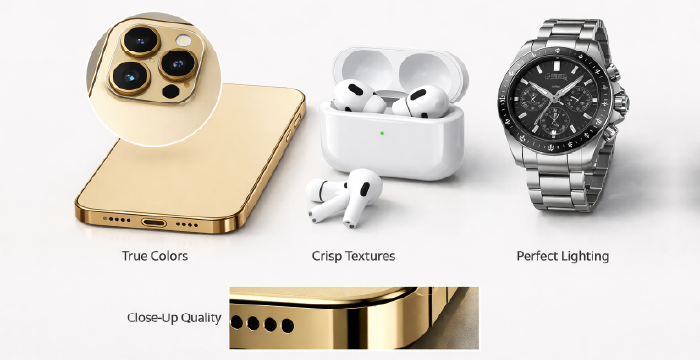
The first thing that catches the eye in the scenario is low-quality flaws like fingerprints, which don’t make it into the final result. Editors start with a resolution of at least 1,600 x 1,600 pixels, so you might think that such a depth would expose some visual noise.
But no, that’s not the case at all; rather, skilled edits remove the blurriness of the product as well as the distractions. That’s why viewers can see clean, crisp textures even after zooming in very deeply.
The original color of the product pulls the audience out of choice paralysis, even with a huge number of options, where they end up clicking add-to-cart. What’s more, when you look at the lighting and shadow work, you’ll see evidence of how much retouching has been done per pixel.
Product-centric Image and Mobile-first Approach
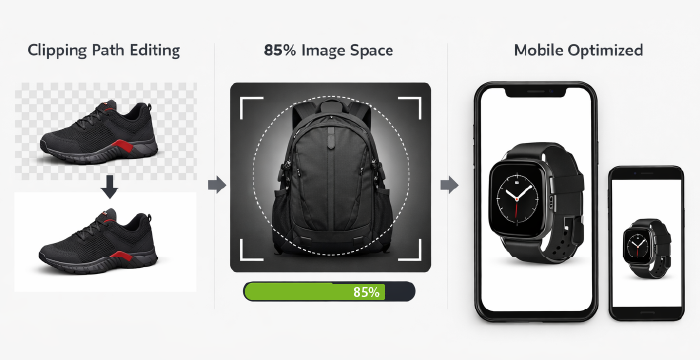
You can see Amazon photo editing services in action when you notice how much the experts take into account when placing products on white backgrounds. They explicitly set it to RGB (255, 255, 255) for screen display and then resort to the clipping path process.
Most Amazon sellers worry about the shelf presence of images, so you must be wondering if the Amazon platform has done anything about it. The answer is yes, they have, and this justifies the popular e-commerce site’s rule of the product occupying 85% of the image space.
You’ll find the editors’ capacity even more powerful when making the product mobile-friendly. Viewers can see the product on any screen, small or medium, with quality contrast.
Ghost Mannequin, Infographics, and Real-life Relevance
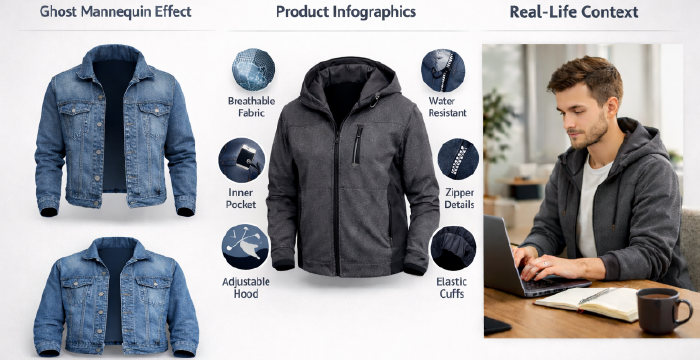
Another key factor behind reaching this 40% of Amazon conversions is the ghost mannequin effect. Your 2D clothing item will no longer be 2D, but you will experience something that is almost 3D.
Not to mention infographics, this alone is enough to provide your audience with a long-term visual learning experience about your product. Here you will understand how a picture speaks and sells.
And the real-world context of the product is basically related to human emotions, where they resonate with the image in harmony with their feelings. When you see something that you like to use in your daily work, being used in the same way in a picture, you definitely wouldn’t avoid it, would you?
Producing Image Assets for 360° Views

The entire visual industry is going through a huge wave of 360-degree product views. So image editors are no longer working with just a static image in their imagination.
What this interactive viewing experience makes possible:
- Spikes dwell time: Viewers spend a lot of time looking at the product from different angles, examining it, and ultimately finding themselves on the product’s ‘takeout’ page.
- plummets product return rates: Since potential customers see and understand the product well before buying, they obviously are no longer dissatisfied after receiving it.
Frequently Asked Questions about Professional Photo Editing for Amazon
1. How much of the entire image does the product need to cover in the Hero Image?
When you upload a hero image for an Amazon listing, make sure that the product occupies at least 85% of the entire image. There is no way to go below this, as it is a platform requirement.
2. What resolution should I set for Amazon product images when editing?
You should go into your photo editing with Amazon product images set to a minimum resolution of 1,600 x 1,600 pixels. This will ensure you get quality results, even so that viewers can get to see the product’s color and texture clearly and give them a proper check.
3. Which position on my Amazon listing should I add infographics to?
You can add 1 or 2 infographics in any position from the 2nd to the 7th of the Amazon listing as a reference to the product in the hero image.
4. How exactly do images with products being used in real life boost Amazon conversions?
When your audience sees products in images that look exactly like they would use them on a daily basis, they feel an emotional connection with the product. This is what ultimately leads them to purchase the product and drive Amazon conversions at the end.
5. What is dwell time in ecommerce business?
Dwell time is the total time a visitor spends on an ecommerce store, or even on a specific product page in that e-store. A higher dwell time means the visitor is liking the product, which increases the likelihood of converting them into a buyer.
Summing Up
Now you know the real secrets of professional photo editing behind the 40% Amazon conversion boost. The more you can give 3D vibes to your product images and make it conducive to visual learning, the more the dwell time of the viewers around the image will increase manifold.
Add to this- the real, practical backdrop of the products and 360-degree views, and you will definitely be able to take your product return reduction to the long term.
However, you must do all this by making the images mobile-first. After all, you certainly don’t want your viewers to be deprived of seeing your best edited images on the screen of any device they use.