
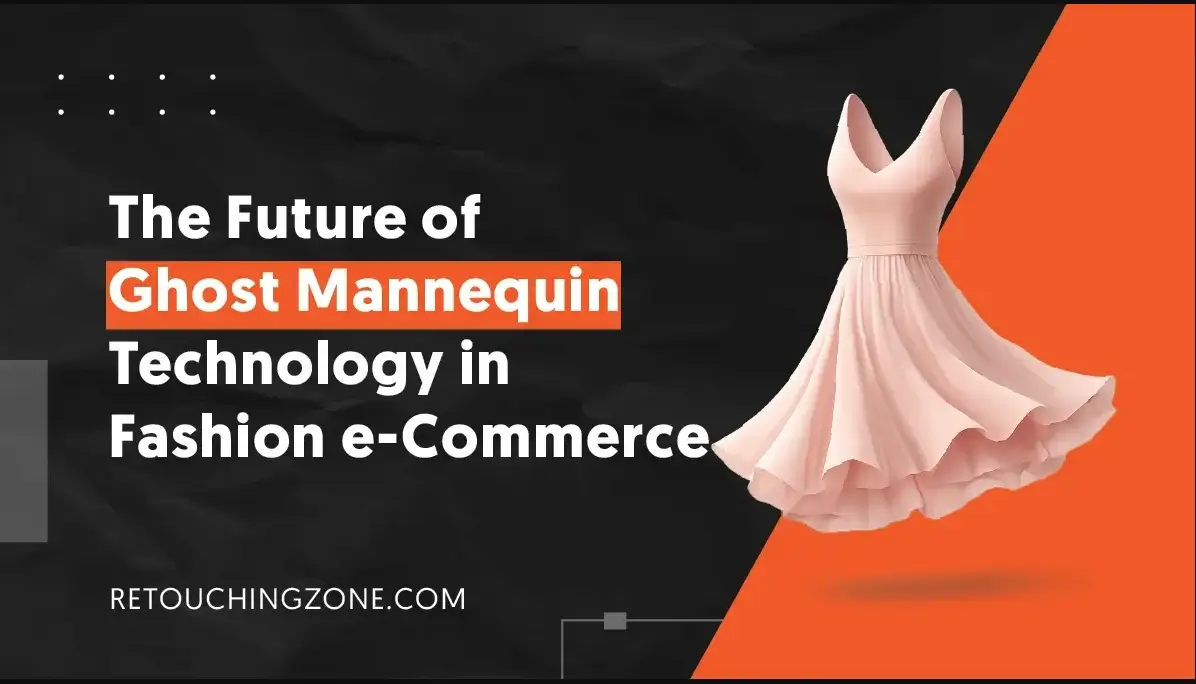
Without the mannequin, any picture of the garment doesn’t look odd at all. You don’t find the model relevant anymore to understand the collar and sleeves very well.
Surprisingly, though, this is the reality that has coincided with fashion e-commerce, almost unnoticed by everyone. Surprisingly, though, this is the reality that has coincided with fashion e-commerce, almost unnoticed by everyone.
The future of ghost mannequins is really promising now that you can’t stop at just creating images of floating garments. You’re interacting with AI in 2026 just when you are moving forward with virtual shopping.
So what more tempting can you imagine coming to apparel product photos?
As industry professionals, we have seen over the years how easily unseen innovations have impacted the needs of editing. In this article, we will bring you the upcoming ones that will keep ecommerce businessmen on the edge.
The Invisible Mannequin That Changed Online Apparel Sales

Fashion sellers had long been going through lots of hassle with showing floating clothes. They used to struggle to make the dress look structurally OK through flat lays in particular.
So the need arose, and that’s where invisible mannequin photography came in. Editors get the details by combining multiple images taken from different angles.
This innovation was coupled with the careful removal of the mannequin during image editing, which left the garments floating in space amazingly. The result was no more hassle of seeing the neckline and the brand tag inside the sleeve shape.
Ecommerce stores don’t have the opportunity for shoppers to touch and inspect the clothes. The images are all there. So this editing technique provides a platform where they no longer have to worry about adding to cart.
AI Is Starting to Handle Tasks That Once Required Hours

You can recall how many hours it took to work on making the neck joint right, can’t you? Regardless of how pro your editors were, they spent tiresome hours wondering if they overlooked something hidden.
Now AI is watching your back to identify the edges of your clothes. There are dedicated AI tools to quickly find sewing marks, which you can also use to detect folds and neck joints in clothes.
But the thing is, this tech is not wholly perfect yet; which is natural, but it improves over time, and it still does. What once took your editor half an hour to do now takes AI seconds.
That said, human image editors haven’t gone completely out of business. Rather, it opens the door for them to be more creative and proactive. This means that they focus on providing quality checks instead of doing photo masking all day long.
Automation Will Reshape Catalog Production

Simply taking a picture of a product with a model and then isolating the model from the pic is not the end of the story. There is much more to do.
Providing a quality background. Correcting colors. Adjusting cropping. Properly inputting metadata. And more…
Each of these steps advances with a considerable amount of resources.
The future of ghost mannequin workflows will essentially make many of these steps faster. It could be like:
| You feed your raw images into a system |
| ↓ |
| The system did all the installing of the entire ghost mannequin effect |
| ↓ |
| The system handled all the editing related to color and cropping |
| ↓ |
| The images were sent for final approval |
The Future of Ghost Mannequin in the Demise of Static Product Photos

You’re already living in this future. From social media to the internet, shoppers are becoming more accustomed to interactive experiences.
This reality is pushing fashion photo editing beyond its limits. People no longer want to see anything unwanted in a package after receiving it at their doors.
You can now take product photos long before post-production, which can cut short the editing episode considerably. And this is the reason behind apparel retailers now leaning into ghost mannequin photography even more dedicatedly.
Photographers now know in advance that they need to shoot with zooming views in mind. And that’s not all. They prepare photo assets in such a way that the photos easily support the 360-degree view.
Virtual try-ons are now at the top of the list of quotes for user experience-conscious store owners.
Shoppers don’t care much about behind-the-scenes. They just want to savor the end result of these techs. So online sellers and marketers won’t have to wait for dressing simulations for long.
3D Garment Visualization as the Future of Ghost Mannequin

The photography you’re about to encounter in the future could blur the line between screen and real life. Because it’s not just about the 3D feel, apparel brands are now busy creating 3D models of their products.
These in-demand image formats are already taking over a large portion of ecommerce photo editing. But why all the fuss?
If you can create a quality 3D clothing model, that’s enough to create multiple views of the product.
Be it:
- Front view
- Rear view
- Top view
- Detail shot
- Close shot
Can you see that this is going to save you thousands of dollars on photo shoots?
The Quiet Renovation of Specialized Editing Services

When technological advancement happens, traditional services, on the one hand, get obsolete, while on the other hand, new services get in line.
You’ve already noticed how keenly brands are turning to outsourcing instead of hiring in-house teams. For good reason, ghost mannequin photo editing services, which have long been around in the industry, are tailoring themselves to serve versatile clients.
In particular, they are taking full advantage of the fact that AI tools are not yet mature. Web applications are often vulnerable to the elegant results that human touch can provide in the inner details of clothing.
What the Industry Might Look Like Five Years From Now

The pattern that apparel imaging is following is sure to see the digital twin take over. Photoshoots may remain entirely at the whim of store owners. But 3D models are inevitable.
As AI becomes smarter, it goes without saying that creating instant ghost mannequin composites will become more of a byproduct.
But the most visible change you’ll see is in quality control, where human decision-making will make AI inspections victoriously effective. Not to mention, creating multiple objects from the same source is already taking over the market.
Now is the time to start seeing how automation tools can thin the time gap between input photos and output results. In fact, the coming competition is going to be based on reducing this time like never before.
Frequently Asked Questions
1. Could blockchain tech impact the authenticity of clothing images in the future?
It could be; you can’t leave the possibility behind. Several retailers are already experimenting with blockchain to verify product ingredients, including image attribution. As the use of AI content continues to grow, this could be a great way to achieve transparency.
2. How much can edge computing advance the production of apparel images?
If you deal with large-scale retail sales, this can be quite profitable for you, since here you don’t have to rely on the cloud. Edge computing speeds up image processing and makes processing so efficient that it facilitates large-scale product launches.
3. Can the invisible mannequin effect technique be useful in the circular and resale fashion marketplace?
Yes, it can. The technique makes the used clothing look more refined, which works well in the resale market. When you add enough detail to your products, it inevitably favors a catalog that goes head-to-head with both the marketplace as well as your targeted buyers.
4. In what cases does ownership of clothing images become important?
When you scale your business, it becomes essential to own your digital fashion assets. In this case, your same clothing images go into marketing and work behind your eCommerce site’s interactive experiences like zooming and 360-degree views.
5. Could the future of ghost mannequin technology harm fashion print media?
Although print media is heavily reliant on static pictures, renovating ghost mannequin still won’t have any negative impact on it. Because the entire focus of the interactive experience will be online, i.e., screen-centric.
Magazines or newspapers can cash in on the combination of this very photo editing techniques with AI, where there will be scope to create a huge image repository in a surprisingly short time.
Pilling Up
Apparel brands around the world aren’t preparing to keep up with the pace of this drastic shift. They’ve already started riding the wave.
So this is not just the future of ghost mannequin technology, but also of fashion ecommerce, which you’ve been in for years.
The ecommerce industry has always been about giving viewers the experience of physically touching clothing, right from its inception. It is becoming visible now and will continue to do so in the years to come, thanks to AI.
But in this upcoming scenario, human participation is not becoming irrelevant, but rather is returning with a new perspective. Because humans are still unrivaled in quality control.
Want to check it out? Then come to Retouching Zone with your vast image assets created by AI.
Enter their free trial and witness with your own eyes what the touch of 12 years of ghost mannequin photo editing expertise can be like.