


15% to 25% of furniture sales end up coming back. Extremely frustrating, isn’t it? And that too for reasons that you could have prevented with a little bit of caution.
When you have the opportunity to learn how furniture brands can reduce returns, why not grab the opportunity! Know that the root of the decline in ecommerce furniture sales lies in the gap between ‘expectations vs reality’.
Your buyers rely solely on the image of your digital store for reading tables, because they don’t have the means to physically sit in it. And so, if they find even the slightest discrepancy between the table and the image, they will return the product.
Go ahead, and along the way, this guide reveals to you how strategic furniture photo editing can reduce your product return rate by 40% to 50%+.
Why Does Sold Furniture Get Returned?
Whether it’s a mirrored dressing table or a bedside tea table, the problem of sending them back to the warehouse no longer exists. For that matter, let us explore the “cause”: Why would a furniture customer reconsider his purchase after getting his delivery?
Expectation vs Reality When Buying Furniture From Ecommerce Sites
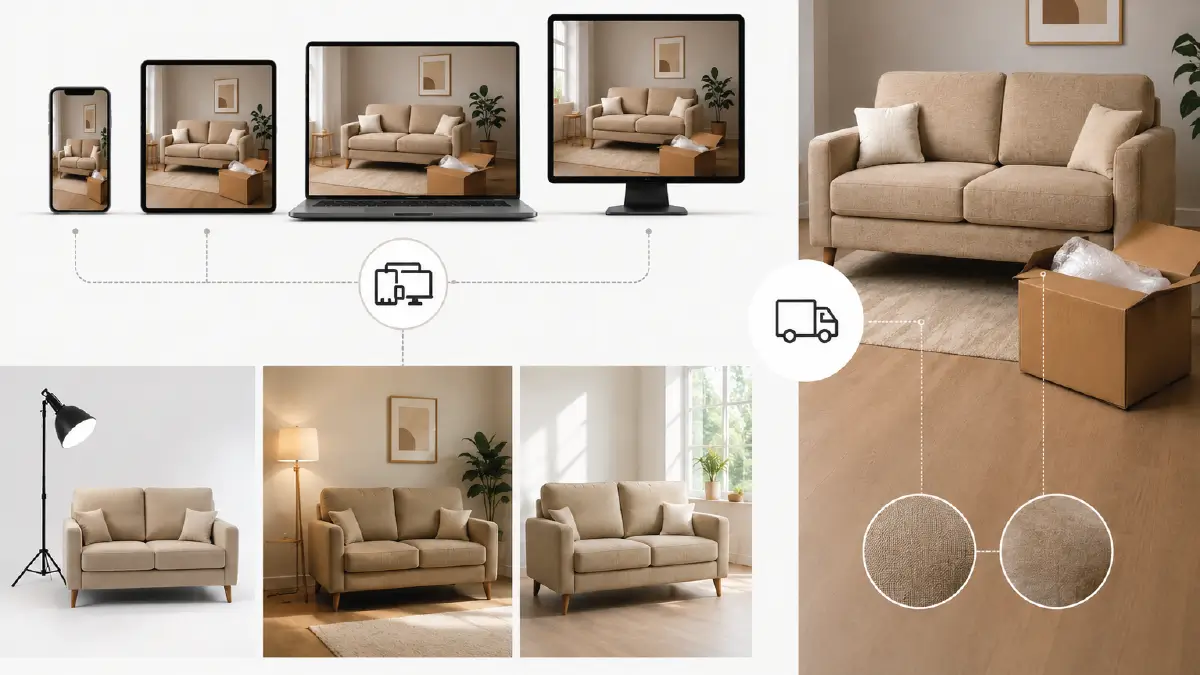
Think about what customers really see when they visit a digital furniture showroom, and what they get when they receive the product. The further apart these two viewing experiences are from each other, the greater the risk of product returns. Now let’s look at the main reasons behind this unwanted discrepancy:
- Different device screens: Your customers use different types of devices (be it smartphones or desktops), and therefore, they view your furniture from a variety of screens. Even though it may look the same to the naked eye, product images can often look different on different screens.
- Different lighting environments: Lighting in different places, such as studios, living spaces, and outdoors, can cause the same furniture to appear different in color.
How Photo Editing Reduces Return Rates (It’s All About Being Strategic)
Take a photo of an oak bed or a leather dining chair taken in a studio. The strobe lights used therein often blur the natural grain of the wood. Also, camera sensors often fail to capture the true color of the material.
Industry-renowned names like Smith Brothers, Knoll, and Arhaus already know how to overcome this drawback. Here are some of the significant post-processing techniques they are currently using to reduce product return rates:
Ensuring Color Accuracy at All Costs
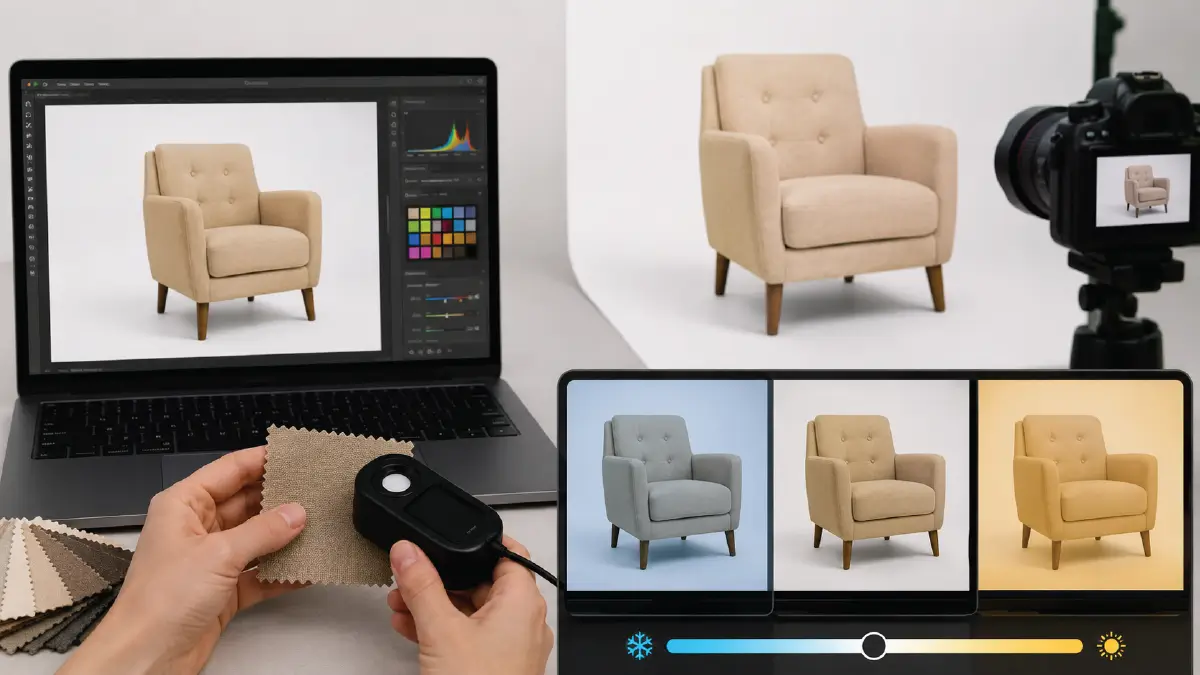
The biggest complaint that customers often make when shopping for furniture e-commerce sites is, “The color doesn’t match the color I saw on the website”. To avoid this complaint, an editor’s expert eye plus a data-driven approach is essential.
- Digital color swatching: Image editors take real-world samples of fabrics or Pantone/RGB codes and cross-check them directly with digital images, using calibrated monitors.
- Hue calibration and white balance: This time, the editor’s job is to remove the artificial blue or yellow cast caused by studio lighting. This is effective for removing the orange-tinged tan of a MacBook screen or the dull brown of an iPhone.
Bringing the Real Substance of Texture and Materials
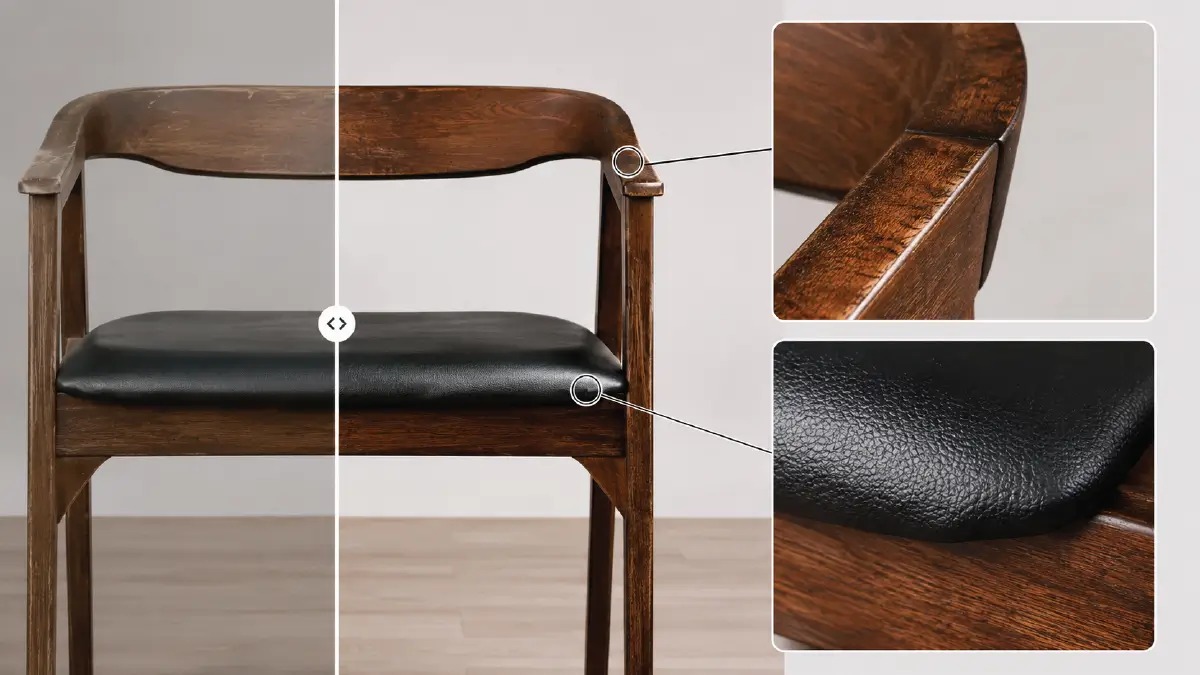
Purchasing furniture without being able to lift, feel the substance of and touch its materials (like running your hand along it) presents an insurmountable challenge to buyers in the online world.
So by any chance they get an old, dull finish, the product will go straight back to your warehouse. Here are the issues that image retouchers give importance to when dealing with this unusual deviation:
- Going into micro details: They closely look at wood grain, the material threads, or the metal’s surface that goes through polishing more than enough. By doing that, they raise up shadows and highlights a lot of the time.
- Taking care of flaws and creases: Retouchers are careful to leave the natural texture of leather or the natural imperfections of wood.
However, they remove skillfully unwanted flaws and creases that may have occurred during shipping.
Providing 360° Views and Deep Zoom Perspectives of Furniture
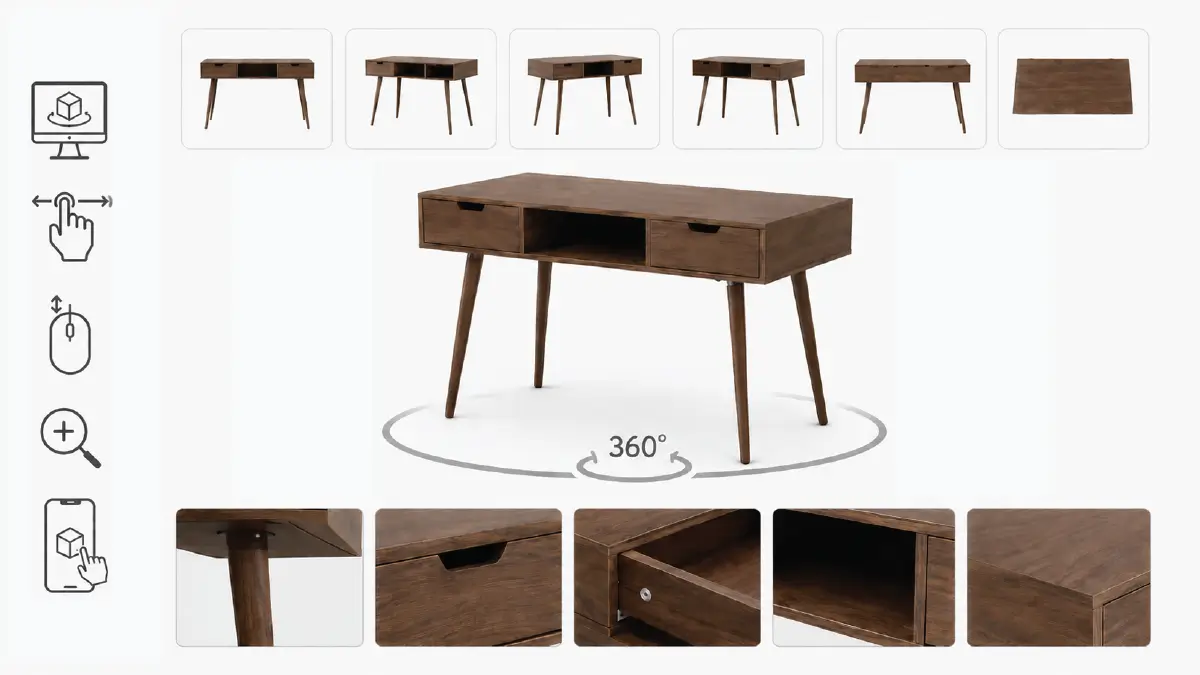
I have seen many times where customers have returned products simply because they didn’t notice that there were no holes for cable management on the top of the table drawer.
The editing processes that give a 360-degree view and zoom perspective of a product are:
- Accommodating different angles and positions: Take every angle and position (like front, back, top, 45 degree angle, close views, etc.) into account when editing your product photos for color, light, and shadow.
- 360° rotation + zoom convenience: This viewing facility goes with your image’s clarity and composition as well as centering, and of course, it does so at the pixel level of each frame. This allows the 360-degree viewer and zooming of the digital showroom to work without any obstacles.
Staging Furniture (3D View) in Lifestyle Shots
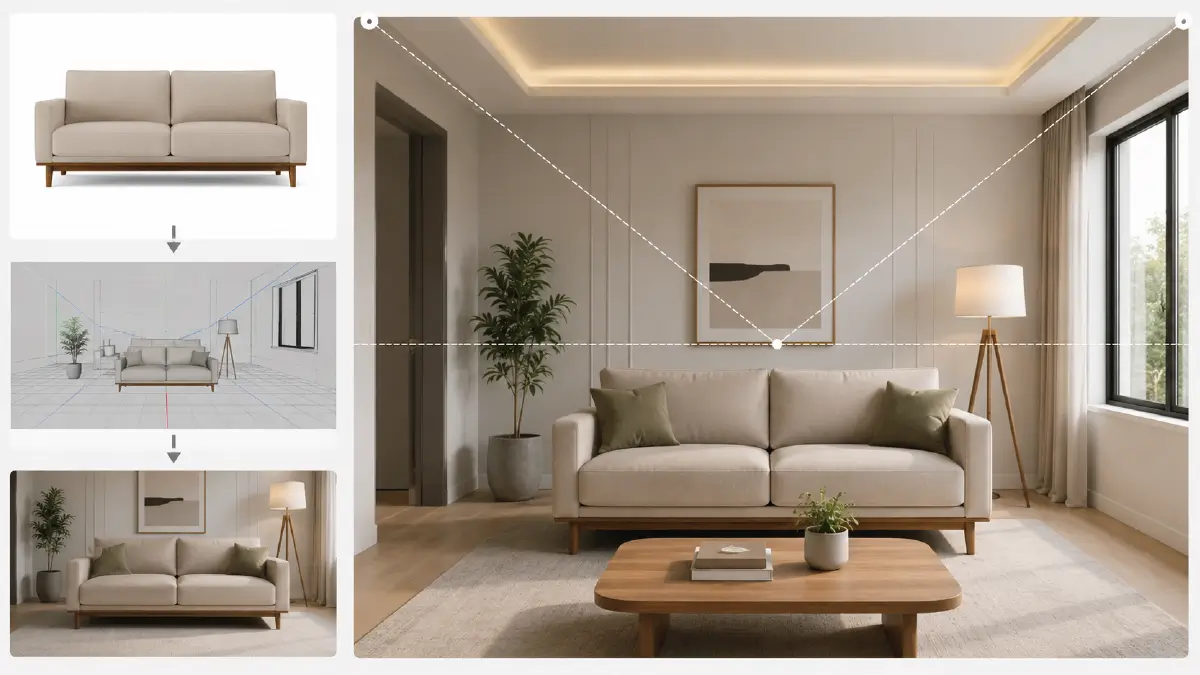
The furniture photo on a white background is not enough to understand the exact size of the furniture. We have seen how much comfort zone a 3D view of the furniture creates for customers when we went to virtual staging. What actually happens here?
- Staging the furniture in a digital room: Photo editors set up the furniture model in a virtual room as if it were a lifestyle shot. Herein, every real-world element, including doors, windows, and carpets surrounding, gets in position exactly the right size.
- Aligning geometrically: If the furniture alignment is not correct with respect to the surrounding conditions, the customer falls into the uncanny valley and immediately misunderstands its size.
And that is why the focal length of the camera and the vanishing point of the product need to match the background.
Furniture Photo Editing Best Practices That Keep Consumers In Touch
In our decade-long experience in the industry, we have seen that if viewers don’t get the impression of care in your editing, they will eventually turn away. Such images often miss the mark you usually get in the real world.
For best practices, the following methods work better, and you can repeat them for your purpose as well:
Bring All the Attention to the Product (Furniture)
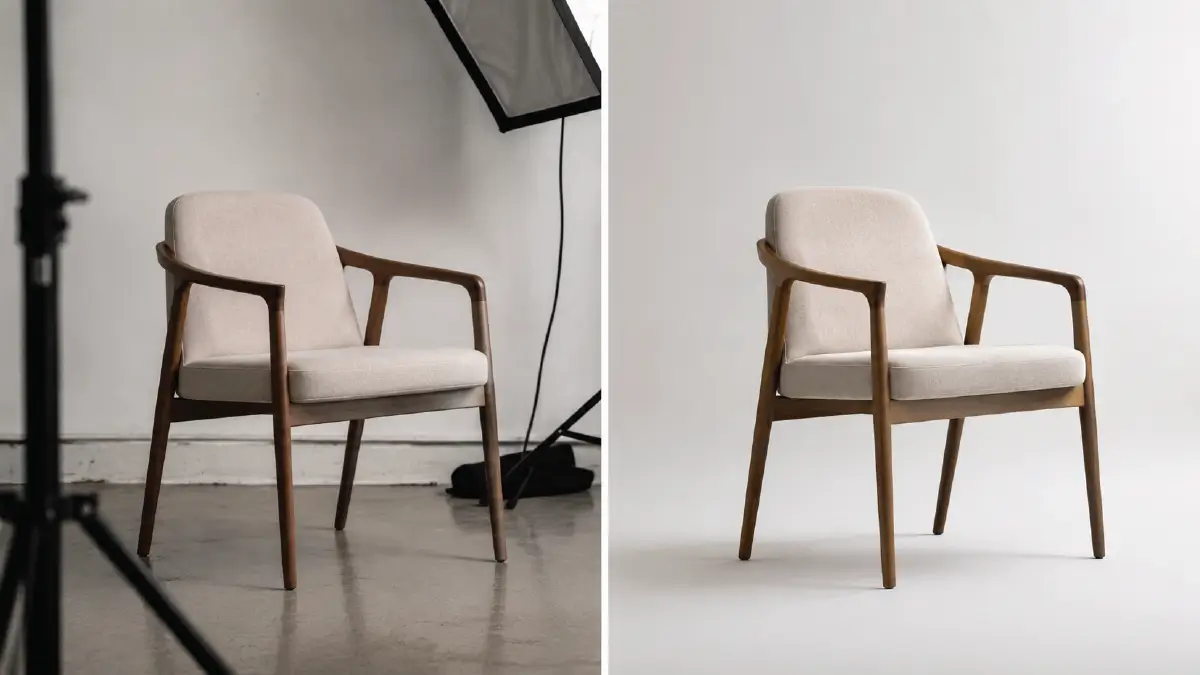
Cleanliness and decluttering take up more than half of the quality of a photo. On the other hand, a photo full of clutter distracts the viewer from the details of the product to the flaws. So the thing to do is-
- Remove distracting flaws: Remove not only all the dirt caused by the studio camera equipment, but also the unwanted reflections caused by the polished metal surface.
- Simplify background: Subtle the vignette or lighten the contrast of the background. You will see that the joints, design, and shape of the furniture pop out to attract the customer’s attention.
Ensuring Depth and Shadow Accuracy
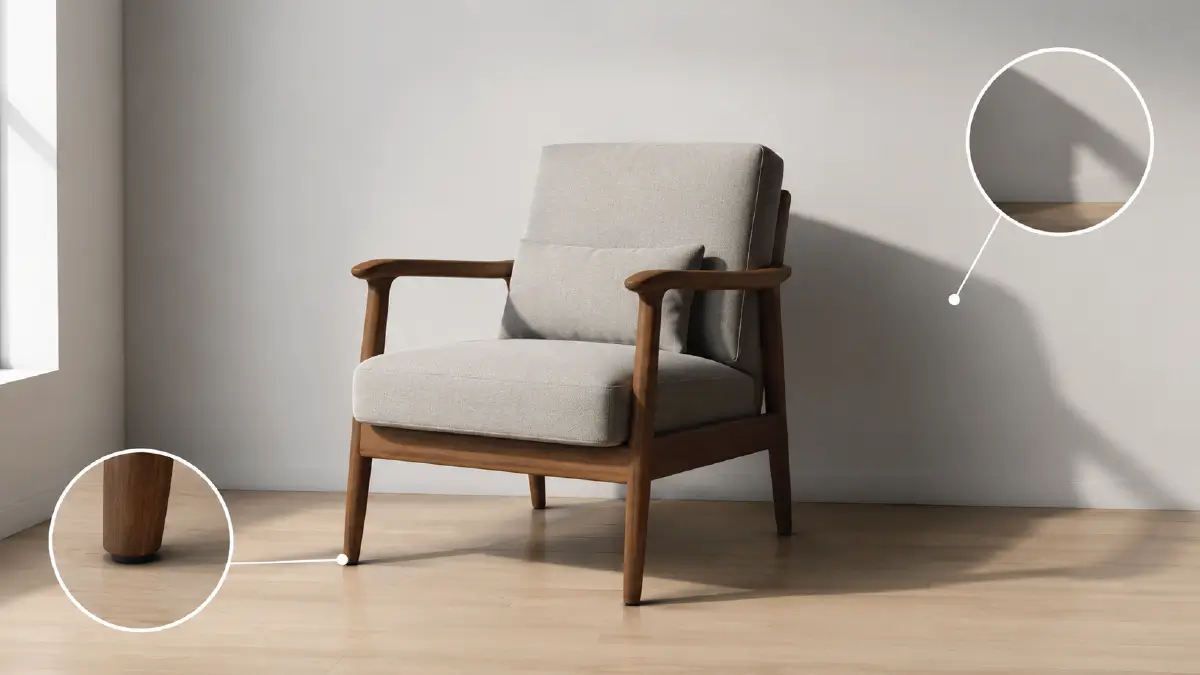
Shadows and depth certainly enhance the quality of furniture images, but you want to keep them optimal if you really want to practice realism.
- Manually draw contact shadows: Draw a dark and clear contact shadow where the ends of the furniture legs touch the floor. Of course, do this manually, drawing by hand.
- Ambient and cast shadows: Create drop shadows by focusing on the direction of light in the room of the furniture.
How Improving SEO of the Site and Its UX Lowers Furniture Returns
Incorrect image file formats prevent visitors from getting a proper view of your furniture. Even inadequate alt text descriptions can distract your potential customers from finding the furniture they want, even though there was nothing wrong with your photo editing.
In this case, what happens is that customers end up ordering one item, getting another, and eventually returning it. And this is where your ecommerce site SEO and UX come together to act.
- Image file formatting: You’ll want to save photos uploaded to your store in WebP format, as it reduces file size by up to 30%. Plus, your visitors can view your images at its highest quality from any device, be it iOS or Android, and any browser, whether it’s Firefox or Chrome.
- Applying lossy compression: Photo editing professionals subject product pages to an algorithm that applies lossy compression to images on those specific pages. As a result, customers can see the furniture photo by zooming in, whereas there is no lack in its texture details.
- Use clear alt tags with clear intent focus: Simple alt tags like alt=”sofa furniture sale” no longer work. Instead, keyword placement should be like this-
alt=”Ergonomic leather gaming chair with footstool, headrest, lumbar height adjustable”.
This works well for your buyers who are more than precise enough in their Google searches.
- Resolution ready for mobile shoppers: Keep the resolution at a minimum of 2000 to 3000 pixels on the longest side, which goes well with today’s high-fidelity smartphone screens.
Mobile customers can see clearer details, such as wood texture on tinier screens, by using the site UX zoom feature.
Frequently Asked Questions for Furniture Photo Edit to Decrease Returns
1. What is a Pantone code?
Pantone code is an identifier from the Pantone Matching System (PMS) that lets image editors spot and duplicate the same color with different materials, no matter the place. For instance, Pantone 186C is a bright medium scarlet red color.
2. How exactly can digital furniture staging be developed?
Also known as virtual furniture staging, this is developed by using CGI or AI. It basically creates a digital scene that contains a 3D model of the furniture in an empty room.
Here, image editors go to a very macro level to ensure the high quality of the image, so that potential buyers can imagine how the furniture will look in their home.
3. How to make sure 360-degree spins work seamlessly on ecommerce product pages?
First, photographers maintain tight control over camera position, focus, and lighting during photo shoots. They take a series of images (about 24 to 72) at motorized intervals. Then, image editors fix subtle image imperfections in post-production.
Then, animators stitch the edited images together during final animation. Their goal is to avoid product exposure anomalies, or “flicker”, and off-axis rotation, or “wobble”.
4. Which furniture images do customers fall victim to the ‘uncanny valley’ experience with?
You’ll often find that some of your furniture looks great in the photos. But when you look closely, you’ll notice some inconsistencies (albeit minor) that don’t go with the real-world furniture at all. Such errors, mostly occurring in AI-generated images, are what make your visitors fall victim to the ‘uncanny valley’ when they see them.
Suppose you see a table leg floating slightly above the floor, or you can’t see one of the two back legs. These situations create distrust in consumers about the product, the store, or the brand it’s associated with.
5. Why should I use lossy compression on my furniture images?
Because when compressing furniture images, lossy compression removes data that is generally less important. And this removal is so deep that it often reduces the size of the image file by almost 70-90%, which in turn increases site loading speed. The best part is that the image quality remains standard despite all this.
Final Thoughts
Screen and real-world perspectives; basically, shrinking the difference between them results in product returns in the furniture business going down. When buyers feel sure about a color, texture, or product size, their willingness to keep the item is improved.
That assurance is the key to making sure the item doesn’t slide back into your warehouse, not ever. But don’t forget to take care of the SEO and UX while doing heavy lifting like virtual staging.
But at this point, you likely realize why having an experienced furniture photo editor team is important for getting visuals to be completely accurate. Needless to say, maintaining the true color and lighting of the furniture and adhering to ecommerce platform compliance is no easy feat.
And that’s where the Retouching Zone comes into play. For over a decade, our team has been working on everything from high-end color correction and micro-texture enhancement to virtual staging.
Take our free trial and see for yourself how the line between your customers’ expectations and reality is blurring for good.