

Clipping path pricing in the USA covers a wider range than most buyers expect — from $0.33 per image for simple product cutouts to $10 or more for complex, multi-layer compositions. What sits between those two extremes depends on a handful of specific factors: how complicated the product shape is, how quickly you need the work done, how many images you’re processing, and whether you’re hiring a domestic agency or an offshore specialist.
If you’re a US-based e-commerce brand, photographer, or agency trying to build a sustainable image editing workflow, this guide gives you the full picture — current market pricing by complexity tier, how different pricing models work, real-world cost scenarios for common use cases, and exactly what to look for when evaluating providers.
What Determines the Cost of a Clipping Path?
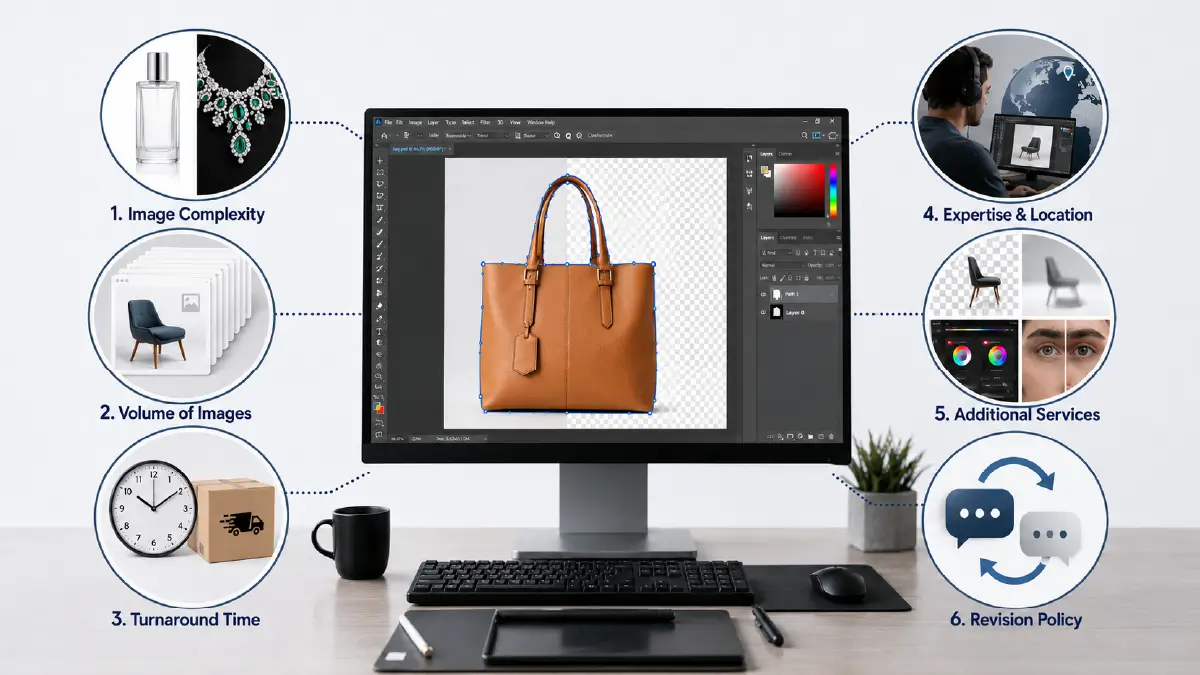
No two clipping path orders are priced identically. Here are the six factors that move the needle most significantly on what you’ll actually pay.
1. Image Complexity
This is the single biggest pricing driver. A glass bottle with smooth, predictable edges takes 3–4 minutes to trace manually. A necklace with fine chain links, irregular gemstone settings, and multiple overlapping layers can take 30–45 minutes on the same image. Providers price accordingly — which is why the industry uses complexity tiers (simple, standard, complex, multiple) rather than flat per-image pricing across the board.
2. Volume of Images
Most professional clipping path providers offer graduated volume discounts. An order of 50 images might be priced at the standard rate; an order of 1,000 images per month from the same client might attract a 15–25% discount. High-volume, long-term clients also often qualify for dedicated team assignments and priority turnaround scheduling — both of which add operational value beyond the per-image rate.
3. Turnaround Time
Standard delivery windows run 24–48 hours for most providers. Requesting same-day or 3–6 hour rush delivery typically adds a 30–100% premium to the base rate. If your workflow is time-sensitive — product launches, catalog deadlines, seasonal campaigns — factor rush pricing into your budget calculations before comparing base rates across providers.
4. Provider’s Expertise and Location
A US-based freelancer with 10 years of Photoshop experience charges differently from an offshore agency in Bangladesh or the Philippines. This isn’t purely a quality distinction — many offshore providers deliver work that meets or exceeds domestic quality standards. The pricing gap exists because of labor cost differences, not necessarily skill differences. What matters is evaluating output quality directly through trials and samples.
5. Additional Services Bundled with the Path
A clipping path is often the starting point, not the finishing point. Many clients need the isolated subject placed on a clean white background, shadows created or corrected, colors adjusted, and surface blemishes retouched — all in a single workflow. Providers that bundle these steps into a cohesive service charge more than those offering standalone clipping paths, but the all-in per-image cost is often lower than commissioning each service separately.
6. Revision Policy
Some providers include unlimited revisions within a quality guarantee. Others allow a fixed number of revisions (commonly 2–3) before charging an additional fee. For clients with exacting quality standards or those working with complex images, the revision policy can have a material effect on total project cost. Always clarify this before placing an order.
Clipping Path Pricing by Complexity — Full Market Breakdown
The industry segments clipping path work into four standard complexity tiers. Here’s how each one is defined, priced, and applied:
Simple Clipping Path — From $0.33/Image
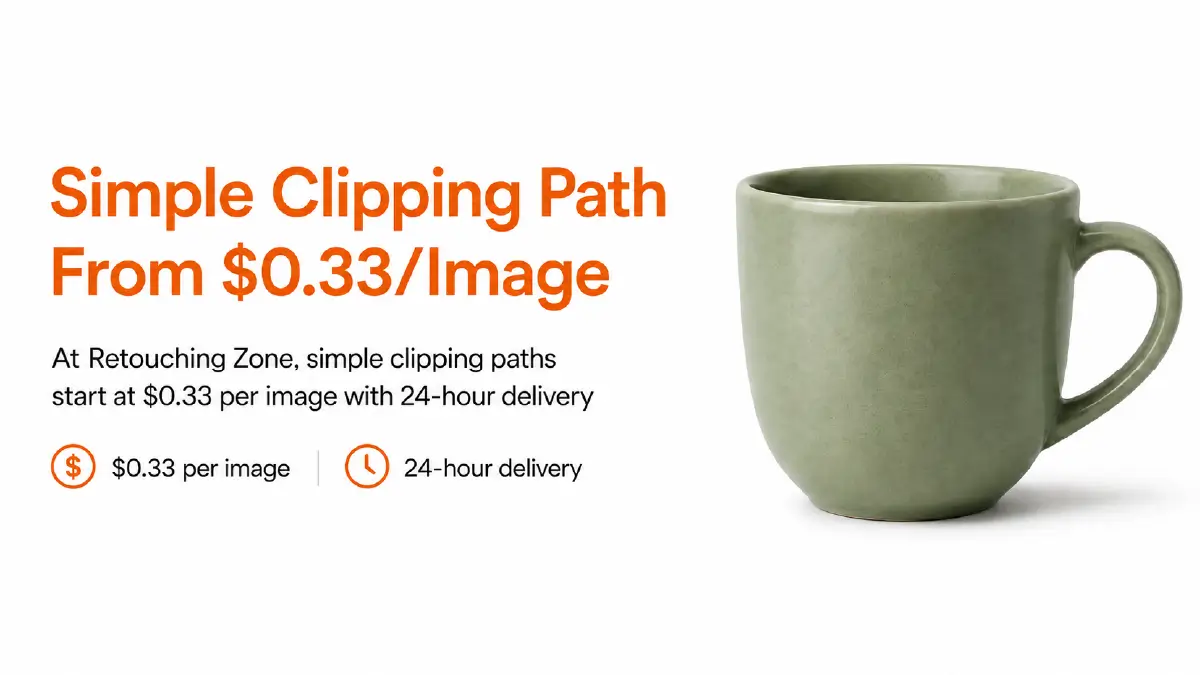
A simple clipping path is used for products with clean, uncomplicated outlines where the edges follow smooth, predictable curves. The Pen Tool path traces the subject boundary in a single, continuous closed shape with minimal anchor points.
Common product types:
-
Round objects: coffee cups, glasses, bowls
-
Rectangular products: books, boxes, packaging, phones
-
Single-piece furniture: chairs, stools, simple tables
-
Basic bags, wallets, and pouches
At Retouching Zone, simple clipping paths start at $0.33 per image with 24-hour delivery.
Standard Clipping Path — From $0.39/Image
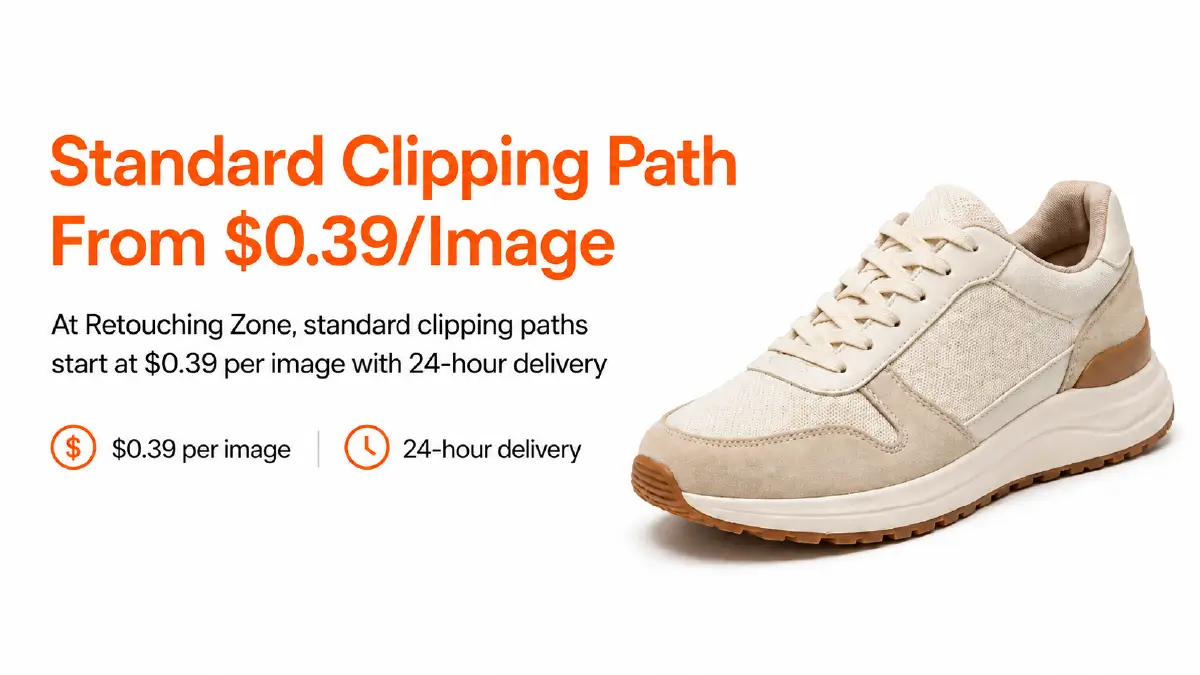
Standard clipping paths handle moderately complex images — those with multiple objects or subjects with moderately irregular edge shapes that require more anchor points and careful curve handling than a simple path. Each object or section is traced individually.
Common product types:
-
Grouped product sets: multiple shoes, watches, or bags in a single frame
-
Jewelry with moderate detail: bracelets, pendants, simple chains
-
Some vehicle components and mechanical parts
-
Multi-piece product bundles with distinct separation between items
At Retouching Zone, standard clipping paths start at $0.39 per image with 24-hour delivery.
Complex Clipping Path — From $3.99/Image
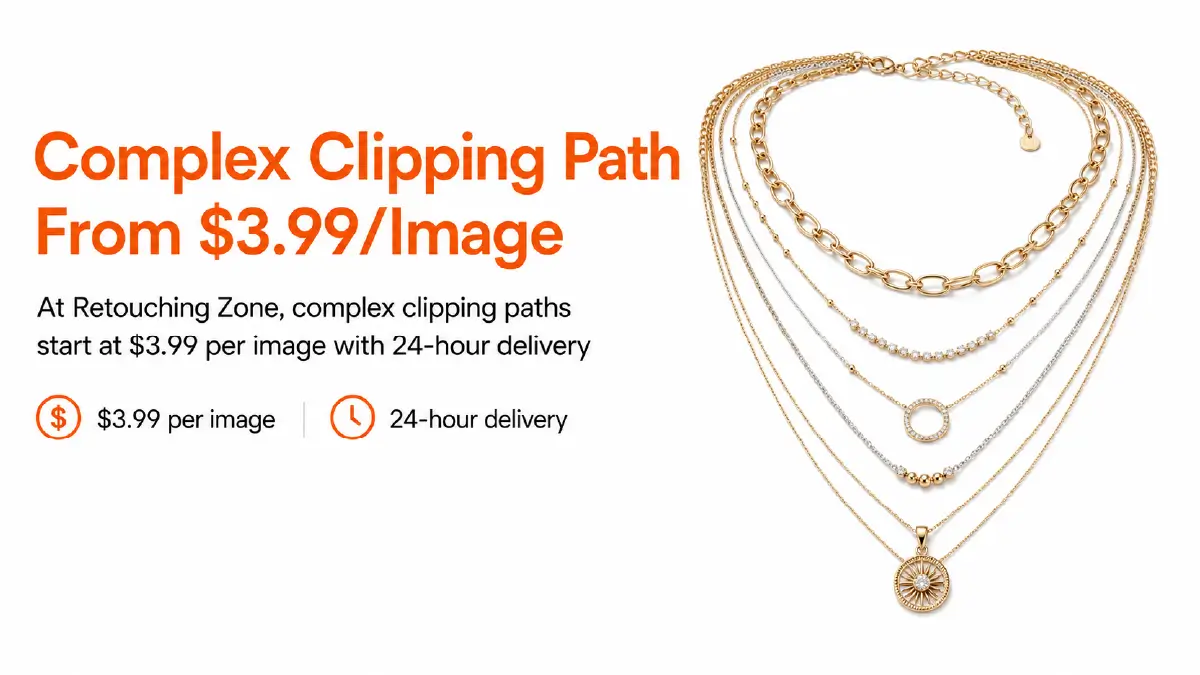
Complex clipping paths are required for images where the subject has highly irregular contours, intricate detail, or multiple distinct sections that each need their own carefully traced path. These paths take significantly more time and require a higher level of Pen Tool proficiency to execute cleanly.
Common product types:
-
Intricate jewelry: multi-chain necklaces, diamond settings, filigree pieces
-
Apparel with fine detail: lace trim, embroidery, crochet, mesh
-
Mechanical products: bicycles, strollers, tools with multiple components
-
Furniture with complex silhouettes: ornate chairs, decorative shelving units
-
Hair accessories and items with irregular, finely detailed edges
At Retouching Zone, complex clipping paths start at $3.99 per image with 24-hour delivery.
Multiple Clipping Path — From $0.99/Image
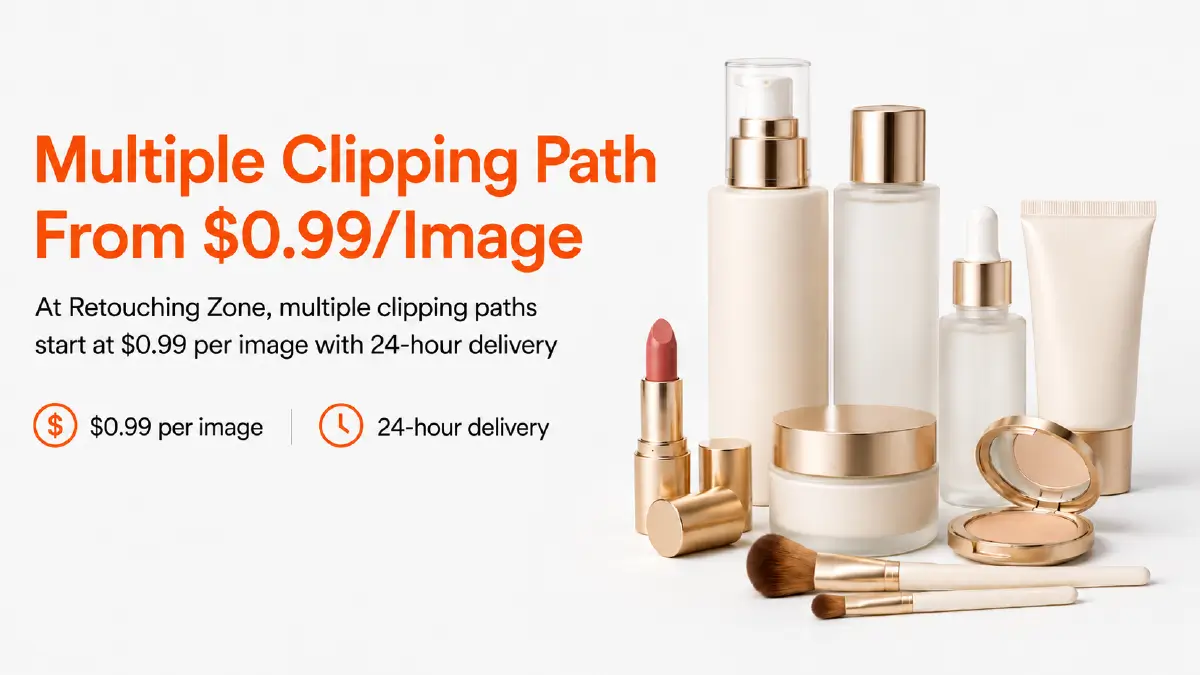
Multiple clipping path (also called multi-path or color path) divides a single product image into separately named path sections — each traced and saved independently. This gives editors and designers the ability to isolate, recolor, or adjust individual components of a product without affecting the rest of the image. It’s the technique behind color variant marketing, where a single product photo is used to generate multiple color options for a website.
Common product types:
-
Cosmetic sets and beauty bundles with multiple components
-
Product collections: toolkits, utensil sets, stationery bundles
-
Jewelry with distinct sections: body, chain, clasp, stone
-
Bookshelf displays and cutout-design objects
-
Apparel with pattern sections that need independent color control
At Retouching Zone, multiple clipping paths start at $0.99 per image with 24-hour delivery.
Clipping Path Pricing Models — How US Providers Structure Their Fees
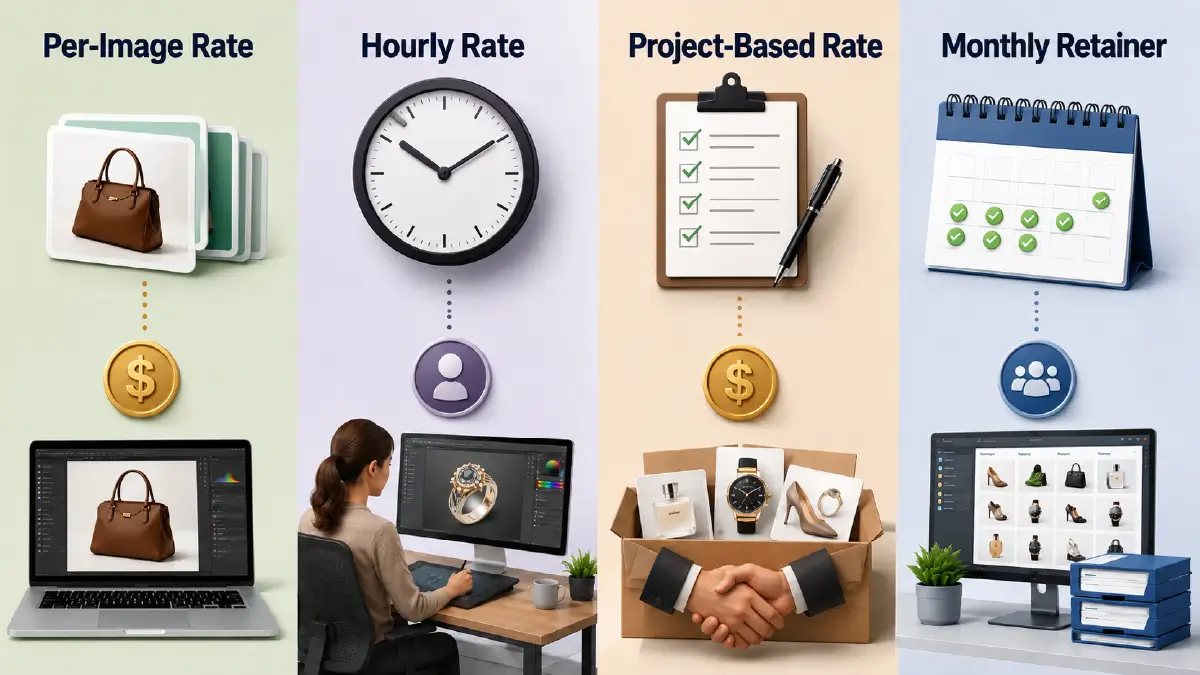
Beyond the per-image complexity tiers, providers offer several different billing structures. Understanding which model fits your workflow is as important as the per-image rate itself.
Per-Image Rate
The most transparent and common model. You pay a fixed price for each image based on its complexity tier. This works well for variable-volume clients — you only pay for what you submit, with no minimum commitment. It’s also the easiest model for comparing quotes across different providers.
Hourly Rate
Hourly billing is typically used for custom or non-standard projects where the scope is difficult to define by image count. Rates range widely: entry-level freelancers may charge $6–$15/hour; experienced US-based professionals charge $25–$75/hour; top-tier specialists with deep industry experience can charge $100–$200/hour. Hourly billing makes the most sense for complex retouching projects, composite builds, or anything requiring extensive client communication during execution.
Project-Based Flat Rate
For defined projects with a clear deliverable — for example, “500 product images for a spring catalog launch, all simple complexity, delivered in 5 days” — some providers offer a single flat project fee. This model reduces financial uncertainty for both sides and is often more economical for large batches than a standard per-image rate applied individually.
Monthly Retainer
Retainer arrangements commit a provider’s capacity to a single client for a defined period in exchange for a guaranteed monthly payment. Retainer minimums typically start around $1,000/month and scale based on committed image volume and service scope. This model suits e-commerce brands and agencies with consistent, predictable monthly editing volumes — it generally delivers a lower effective per-image rate and higher workflow priority than on-demand ordering.
Volume Discount Tiers
Most professional clipping path providers publish volume discount thresholds. A typical structure:
At Retouching Zone, volume discounts reach up to 25% for high-volume monthly clients.
Real-World Cost Scenarios
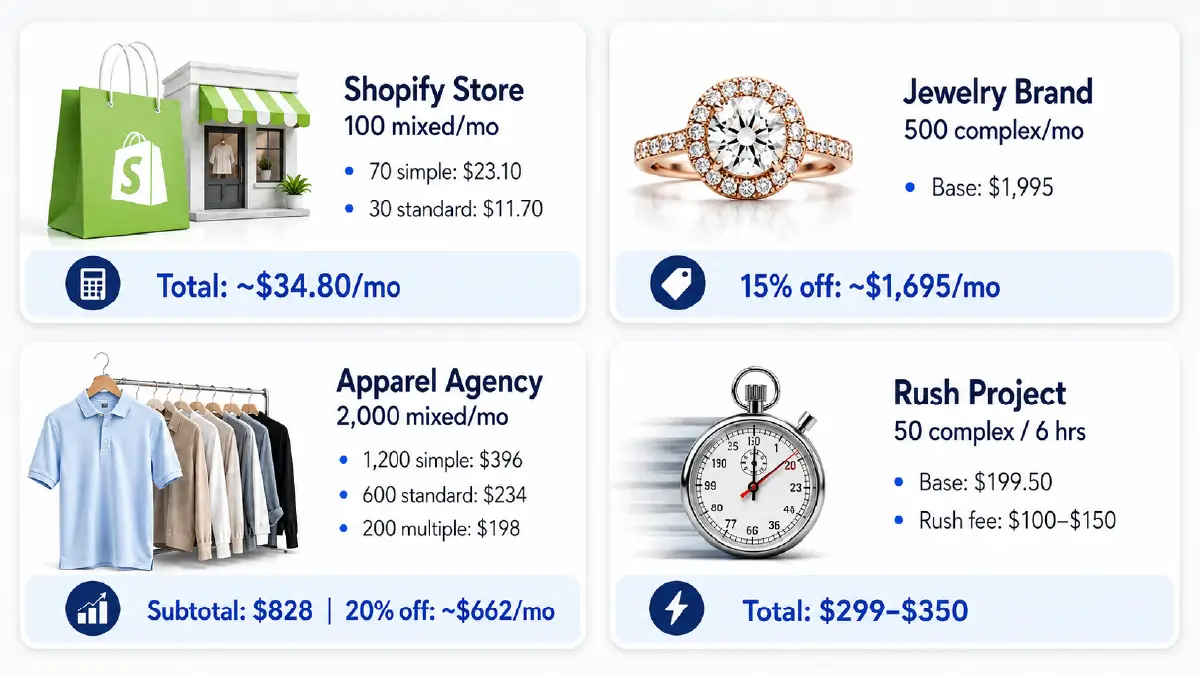
These examples give you a practical sense of what typical clipping path orders actually cost at current market rates.
Scenario 1 — Small Shopify Store, 100 Mixed Products/Month
-
70 simple images × $0.33 = $23.10
-
30 standard images × $0.39 = $11.70
-
Total: ~$34.80/month at standard pricing
Scenario 2 — Jewelry Brand, 500 Images/Month (Complex)
-
500 complex images × $3.99 = $1,995
-
With 15% volume discount: ~$1,695/month
Scenario 3 — Apparel Catalog Agency, 2,000 Images/Month (Mixed)
-
1,200 simple × $0.33 = $396
-
600 standard × $0.39 = $234
-
200 multiple × $0.99 = $198
-
Subtotal: $828 — with 20% volume discount: ~$662/month
Scenario 4 — Rush Project, 50 Complex Images in 6 Hours
-
50 images × $3.99 base = $199.50
-
Rush surcharge (approximately 50–75%): $100–$150
-
Total estimate: $299–$350 for same-day delivery
DIY vs. Outsourcing — The Real Cost Comparison
Many businesses initially consider doing clipping paths in-house to save money. Here’s the math that usually changes their mind.
An experienced editor working at a professional pace can complete approximately 10–15 simple clipping paths per hour. A more realistic rate for consistent, quality output across a mixed-complexity batch is 6–10 images per hour.
Beyond direct cost, outsourcing eliminates software licensing costs, quality control overhead, training time for new employees, and the operational bottleneck that occurs when internal editors fall behind during high-volume periods.
What to Look for When Choosing a Clipping Path Provider in the USA
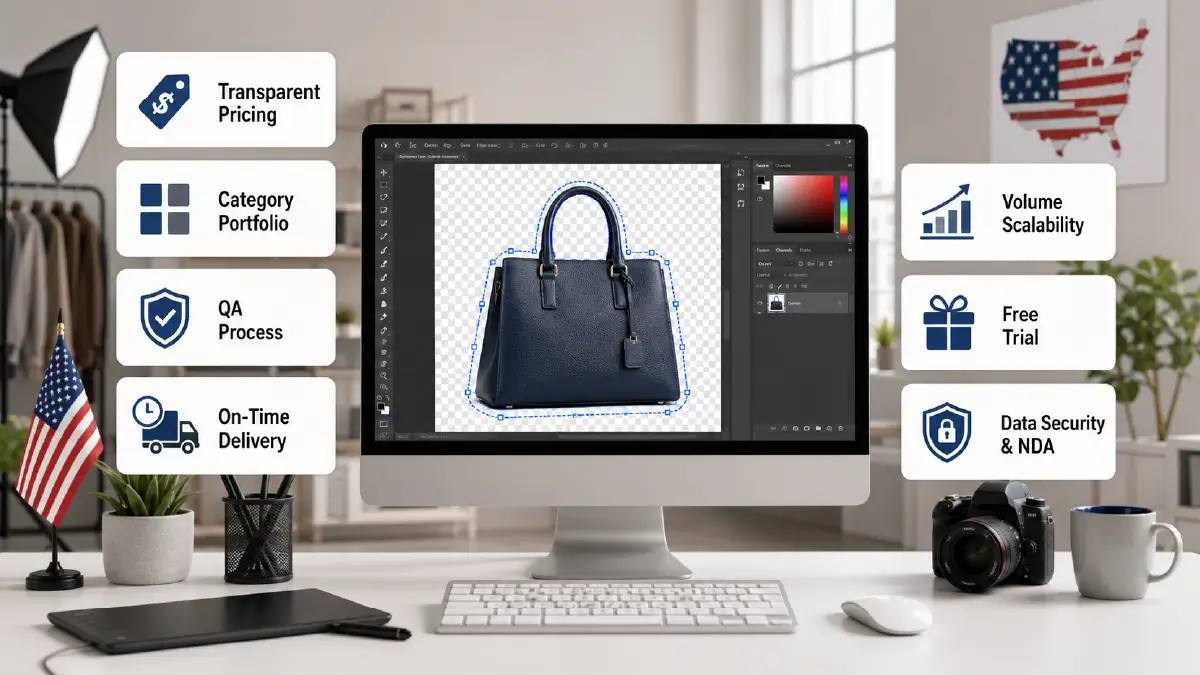
With dozens of providers competing for the same business, here’s how to cut through the noise and find the right fit for your specific needs.
Transparent, Itemized Pricing
A trustworthy provider publishes their per-image rates by complexity tier without hiding add-on fees in the small print. Before signing any agreement, ask explicitly: Are revisions included? Are there fees for rush delivery? Does file format conversion cost extra? A provider that answers these questions clearly upfront is far easier to work with than one that surprises you with line items after delivery.
Verifiable Portfolio in Your Product Category
Request work samples specifically in your product type — not a general highlight reel. A provider that excels at jewelry photography might not have the same depth of experience with industrial machinery. A strong, category-specific portfolio tells you more about the fit than any sales conversation will.
Quality Assurance Process
Ask what their quality control process looks like. How many checkpoints does an image pass through before delivery? Is QC handled by a dedicated reviewer or the same editor who did the original work? Providers with a structured, multi-step review process — like Retouching Zone’s 3-layer QC system — consistently deliver more reliable first-time approval rates than those relying on individual editor judgment alone.
Turnaround Reliability
Standard turnaround time means nothing if a provider routinely misses it. Check client reviews specifically for on-time delivery patterns. Ask for their on-time delivery rate as a percentage — a credible provider will answer this question directly. Retouching Zone maintains a 99.6% on-time delivery rate across all standard orders.
Volume Scalability
If your business is growing, your editing partner needs to grow with you. Ask directly: what’s your daily capacity? How do you handle a sudden 3× spike in volume? Can you assign a dedicated team to our account at higher volumes? A provider that can’t answer these questions confidently is a risk for any business with seasonal peaks or rapid growth.
Free Trial Before Commitment
Any reputable clipping path provider should offer a free trial — typically 2–5 images processed at no charge — before you place a paid order. Use this to evaluate not just image quality but also communication responsiveness, file delivery format, and whether the result matches your brief. If a provider doesn’t offer a free trial, that’s a meaningful signal about their confidence in their own output.
Data Security and NDA Policy
Your product images are proprietary assets. Confirm that the provider has a formal privacy policy and is willing to sign a non-disclosure agreement (NDA) before work begins. Any professional-grade provider will have standard NDA documentation ready to send. If they hesitate or don’t have one, that’s a red flag.
Retouching Zone Clipping Path Pricing at a Glance
All plans include:
-
3-layer quality control on every image
-
24/7 customer support
-
Free revisions on first-time orders
-
NDA and data privacy compliance
-
No upfront payment — pay after reviewing delivered work
Frequently Asked Questions
How much does a clipping path cost per image in the USA?
Prices range from $0.33 per image for simple products with smooth edges up to $10 or more per image for highly complex subjects with irregular shapes and fine detail. Standard market pricing tiers are: simple ($0.33–$1.50), standard ($0.39–$3.00), complex ($3.99–$10.00+), and multiple path ($0.99–$5.00). Volume discounts of 15–25% apply at most professional providers for orders of 500+ images per month.
Why does the clipping path price vary so much between providers?
Several factors drive the price gap: image complexity, provider location (US-based vs. offshore), turnaround time, quality control standards, and whether additional services like background removal or shadow creation are bundled in. A US-based freelancer charging $50/hour and an offshore professional agency charging $0.39/image can both deliver high-quality results — the difference is in the operational model, not necessarily the output quality.
How much do rush or same-day clipping path services cost?
Rush delivery (3–12 hour turnaround) typically adds a 30–75% surcharge to the base rate. Same-day delivery (under 24 hours) can add 50–100% depending on volume and provider. If your workflow regularly requires fast turnaround, negotiating a retainer agreement with a dedicated team is usually more cost-effective than paying per-order rush fees.
Who typically needs clipping path services in the USA?
E-commerce retailers and Amazon sellers make up the largest segment, followed by product photographers, advertising and marketing agencies, print and publishing houses, real estate visualization firms, and fashion brands. Any business that regularly produces product images for online or print use is a likely client for ongoing clipping path services.
How do I protect my images and data when working with an offshore provider?
Request a signed Non-Disclosure Agreement (NDA) before sending any files. Reputable providers have standard NDA documentation ready to send immediately. Also verify that the provider’s privacy policy covers data protection, that files are transferred via secure channels (SFTP or encrypted file-sharing platforms), and that images are deleted from their servers after delivery.
Do clipping path providers offer free revisions?
Policies vary. Most professional providers include 2–3 free revisions within their quality guarantee. Some, like Retouching Zone, include unlimited revisions on first-time orders until the client is satisfied. Always confirm the revision policy in writing before placing an order, especially for complex or high-volume projects.
What file formats support embedded clipping paths?
PSD, TIFF, EPS, and PDF all support embedded vector clipping paths that can be recognized by layout software like Adobe InDesign and Illustrator. PNG supports transparency (alpha channels) rather than embedded paths. JPEG does not support transparency or embedded paths — it’s used for final web delivery only, after the path and background work is complete.
Is it worth outsourcing clipping paths, or should I do them in-house?
For low volumes (under 50 images/month), in-house editing may be manageable depending on available staff time. For volumes above 100 images/month — especially across mixed complexity levels — outsourcing consistently proves more cost-effective when you factor in editor time, software costs, quality control overhead, and the opportunity cost of diverting skilled team members from higher-value work. Most growing e-commerce brands reach the outsourcing tipping point at 100–200 images per month.
At the End
Clipping path pricing in the USA is more transparent than it used to be — most professional providers publish per-image rates by complexity tier and offer free trials before you commit to a paid order. The practical questions are simpler than they look: What’s your monthly volume? What’s the typical complexity of your product images? How quickly do you need delivery? Answer those three questions clearly and you can get an accurate quote from any reputable provider within minutes.
If you’re ready to see what professional clipping path quality looks like on your own images, Retouching Zone offers a free trial with no upfront payment — simple, standard, complex, or multiple paths, delivered within 24 hours and reviewed before you pay a cent. Request a custom quote for volume pricing tailored to your monthly needs.