
Best File Formats for Ecommerce: Balancing Quality and Performance
The best product image file formats for ecommerce websites come with advantages in terms of how quickly the image can be viewed and how much detail it can display. You might say it in one word- high quality, but alone this is not enough.
Images that are too high in quality and resolution slow down website loading speed, which affects the SEO and overall performance of the site. You need to display your products clearly while maintaining optimal website performance.
A proper image format helps you maintain these fundamental aspects. So, let’s learn what are the best file formats for ecommerce product images in 2026, which ones to use in which situations, and a few best practices.
Why File Formats Matter for Ecommerce?
- Improves user experience by optimizing loading speed
- Preserves the standard image quality and resolution
- Compatibility with web technologies like HTML, CSS, and JavaScript
- Maintains storage efficiency
- Improves the overall ecommerce website responsiveness
- Compatibility with product type and business type
- Optimizes the overall SEO performance
Popular File Formats for Ecommerce Product Images
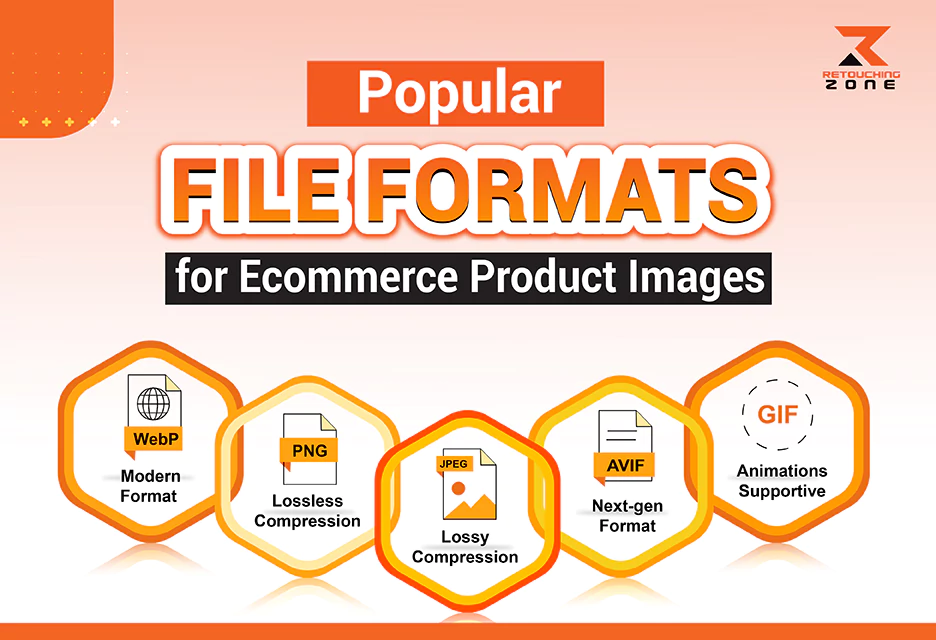
As in recent years, the most commonly used best file formats for high-quality e-commerce images in 2026 are:
01. JPEG – Lossy Compression
Around 74% of ecommerce websites have JPEG format images. JPEG is ideal for reducing image file sizes substantially while maintaining reasonable image quality. It helps reduce the file size by up to 70–90%.
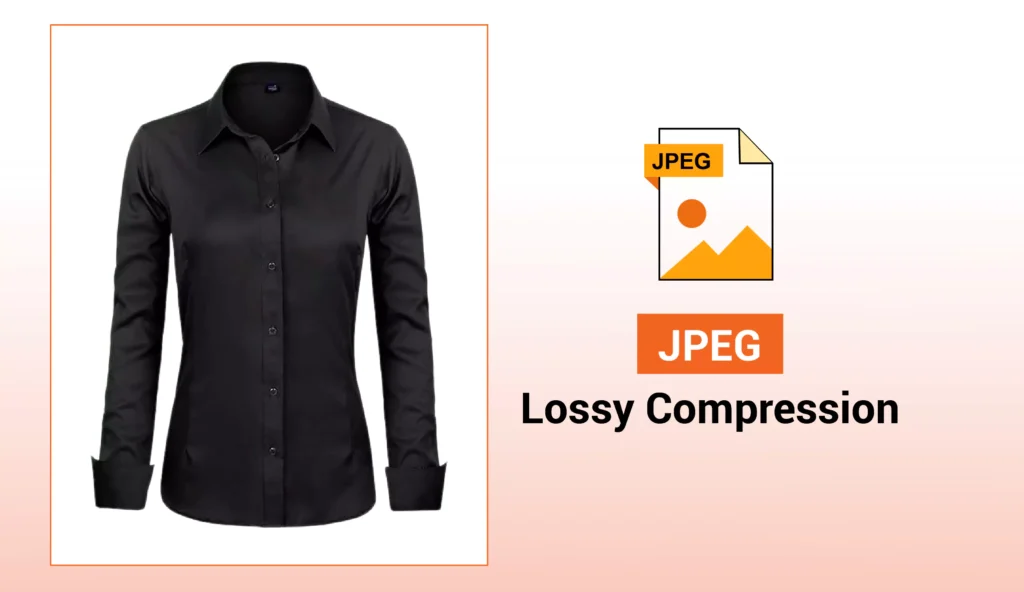
Product photos with complex color gradients, such as those of clothing and electronics, are best suited for the JPEG format.
Pros
- Small file sizes
- Good for complex images
- Support for millions of colors
- Fewer bandwidth costs for website owners
- Adjustable compression quality
- Better user experience
Cons
- Loss of quality with heavy compression
- Limited metadata support
- Not suitable for transparency
02. PNG – Lossless Compression
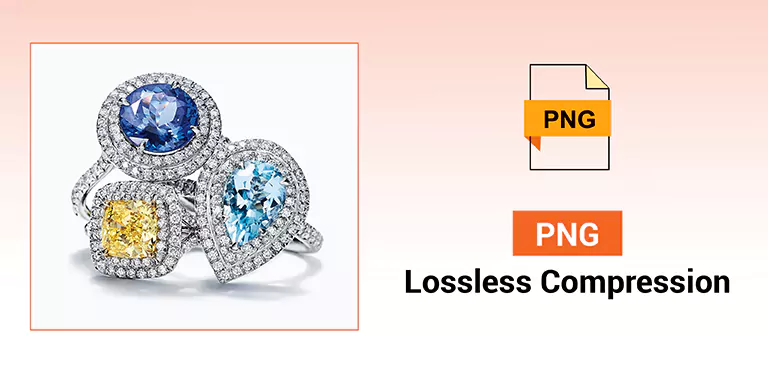
PNG is the best format for lossless compression. It retains the original quality even after editing the files. You won’t have to worry about blurriness or distortion.
PNG can cause storage bloat in your ecommerce sites due to large file sizes. That’s why only 14.4% of web images are in PNG format.
It is best for products that require showcasing intricate details, such as sharp lines and edges.
Pros
- High-quality product images
- Compatible with modern browsers and operating systems
- Display millions of colors
- Wider acceptability
- Supports a broader range of color depth or gamut
- Preserve the image’s original data
- Maintains pixel-perfect clarity
Cons
- Larger file sizes
- Not widely supported
- Affect loading time
- Less effective image compression
03. WebP – Modern Format
Approximately 13% of e-commerce websites utilize WebP images. WebP is a better format for creating smaller, richer images. It can reduce the file size by up to 25% to 35% during compression. The overall compression is better than JPEG and PNG.
Google developed this modern image format. Hence, it can increase the search engine optimization rankings of your online site on Google. WebP format is suitable for a wide range of product images.
Pros
- Smaller file sizes than JPEG/PNG
- High-quality images
- Efficient compression process
- Support transparency for animation and alpha
- Mobile-friendly less occupy of storage space
- Reduced storage space usage
Cons
- Not compatible with older browsers
- Slight quality degradation from compression
- Not support some editing software
04. AVIF – Next-gen Format
AVIF is widely used in modern browsers. It supports various color spaces, including HDR, SDR, and CICP. AVIF offers superior compression capabilities compared to traditional formats.
This next-generation image format is excellent for accurate, vibrant color reproduction. It can handle product color and details in a clear and concise manner.
If you need high-quality product images on cutting-edge platforms or subtle gradients, AVIF is the best choice.
Pros
- Excellent quality-to-size ratio
- Supports HDR, SDR, CICP, etc.
- Space saving and faster loading
- Preserves excellent detail and colors
- Wide color gamut support
- Supports different resolutions and quality levels
- Open-source and royalty-free
Cons
- Emerging format
- Not compatible with some browsers
- Time-consuming to encode and decode
- Not compatible with some tools and programs
05. GIF – Animations Supportive
GIF is well-known for its universal compatibility. You can use it to convey emotions, reactions, and ideas about your ecommerce products.
Ecommerce businesses use GIF product images to grab and hold customers’ attention and maintain customer interest.
GIF formats are great for highlighting the versatility of a product. Besides, it can help you showcase animated product demos, simple icons, buttons, icons, and charts.
Pros
- Small files for faster download and loading
- Support transparent backgrounds
- Best choice for simple graphics
- Compatible with all devices and browsers
- Simple to create
- Effective for creative marketing in ecommerce
Cons
- Poor quality for detailed images
- Limited color scheme
- Can’t be edited
Key Considerations for Choosing File Formats
The following are primary import points not to overlook when selecting a specific file format for ecommerce sites.
Image Quality
Choose standard-resolution images. A product’s color should be accurate. But it must have a reasonable sharpness level to highlight product details.
File Size
Keep the file size small, but don’t reduce the quality below the standard level. It improves loading speed and shopping experience.
Compatibility
Select a versatile file format that supports both mobile and desktop versions. It should also be highly responsive on various web browsers in different versions.
Primary Purposes
Select a suitable format based on the product type, e-commerce business type, and other relevant attributes. For example, PNG format is better for products with intricate details. But JPEG is suitable for products with complex color gradients.
Transparency
Products like clothing need transparent backgrounds. PNG and WebP are the best choices for a higher level of transparency.
Best Practices for Using Product Image File Formats
Thanks to the best file formats for high-quality e-commerce images, they have been enriched with situational use cases. The practices are literally strategic practices for good reason, and those are:
Use Compression Tools to Optimize Images
TinyPNG is an excellent compression tool for processing PNG and JPEG images. It removes data redundancy without compromising on quality. ImageOptim is also effective at eliminating bloated metadata and reducing file size.
Create Responsive Visuals
Add a srcset attribute to the HTML product image tag to create responsive images. This makes the product images versatile to show on various devices.
Set Up CDN for Your Ecommerce Site
Use a CDN to process the image in real time, speeding up image delivery. It ensures fast loading, even for high-resolution product photos.
Test Compatibility
Perform compatibility testing to run your ecommerce site smoothly on all devices, browsers, and operating systems.
Consider Website Requirements
Ecommerce platforms like Shopify and Amazon have strict requirements for image formats and sizes. Follow their terms and conditions to improve your ranking.
Maintain Consistency
Use the same image formats across all product listings to ensure professionalism. It improves the overall website performance.
Frequently Asked Questions about Best File Formats for Ecommerce Images
1. Which product image file formats for ecommerce websites are best for fast loading?
WebP and AVIF are the best for loading speed. WebP can reduce file sizes by 25% to 35% compared to JPEG, while AVIF offers even superior next-gen compression to keep your site responsive.
2. When should I choose PNG over JPEG for my product photos?
You should use PNG when your product requires pixel-perfect clarity, has intricate details (like jewelry), or needs a transparent background, as JPEG does not support transparency.
3. Can using the wrong image format affect my store’s Google ranking?
Yes. High-resolution images in the wrong format can slow down your website. Since Google uses page speed as a ranking factor, well-optimized formats like WebP can help improve your SEO performance.
4. Is GIF a good format for showing high-detail products?
No. GIFs have a limited color scheme and are poor for detailed images. They are best used for simple animations, product demos, or creative marketing icons rather than primary product photos.
5. What is the benefit of using the AVIF format in 2026?
AVIF is a next-generation format that provides an excellent quality-to-size ratio and supports a wide color gamut (HDR). It is ideal for vibrant, high-quality images on cutting-edge platforms.
Conclusion
This clear-cut guide to product image file formats for ecommerce websites is set to help you grow your digital store in the long run. Because as time goes by, you’ll need more content, and so more images.
You need to keep your site’s performance consistent at all costs. Balancing image quality and file size creates faster loading speeds. It also improves the user experience.
Very large, high-resolution images unnecessarily use up extra storage space. Compressed and well-optimized images rank higher in search engine rankings.
This way, as your online business advances, your content volume will continue to expand, without your site slowing down and dropping visitors.