

When the image is of shoes, it naturally comes to your mind for good reason that how exactly to show it to your store visitors. It’s no surprise that the debate over on-foot vs white background shoe images is heating up, but it needs to be.
Just having a product in a photo isn’t everything, rather, how you show the photo in certain places and in what way matters a lot.
Lifestyle images are just as important to eCommerce owners as hero images. Even on a very small scale, mispositioning of images can pose a bigger challenge to audience engagement, which can lead to a decrease in sales.
Stay tagged with our blog. You will learn how modern footwear brands should deal with white backgrounds and on-foot shots in shoe photos.
Where Are On-Foot Shoe Images Mostly Relevant?
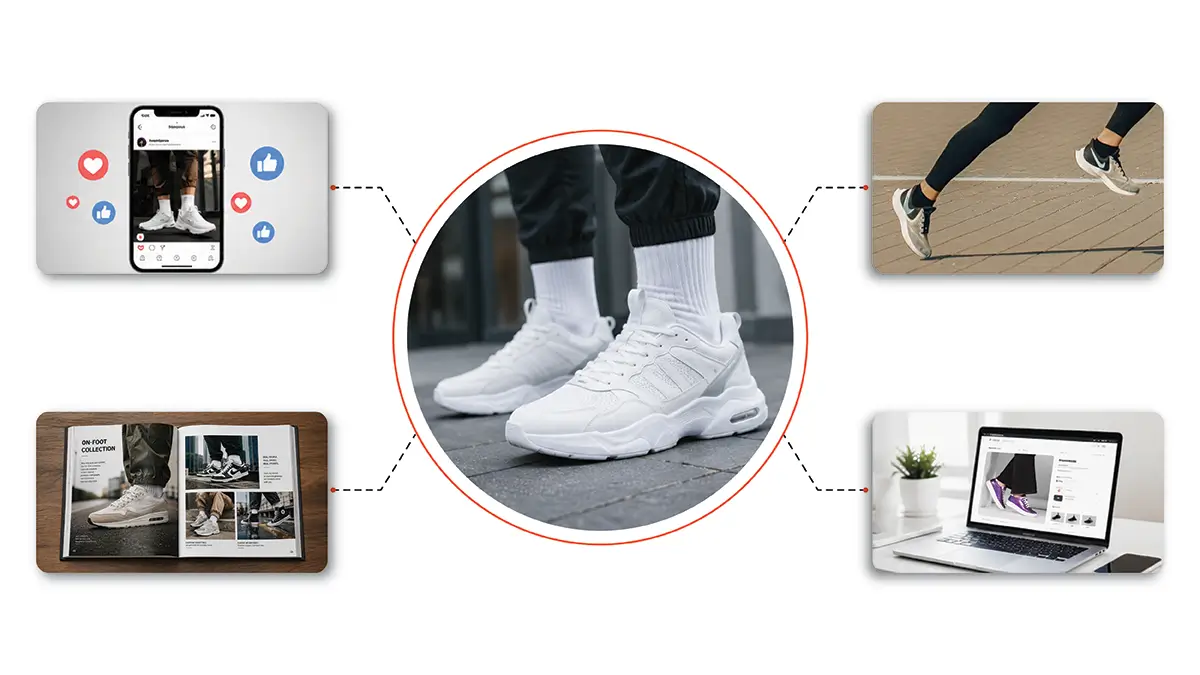
How much do pictures of celebrities wearing shoes on Facebook or Instagram inspire your imagination? When you see a picture of an athlete running in sneakers, you can instantly picture yourself wearing those.
| Because of the fact that ordinary people can relate so easily, on-foot shots are all over social media. |
It also works equally in corporate areas, of course with a different audience focus. The footwear-centric mags and books feature on-foot photos, all credit for which goes to their ability to convey context very well to the intended audience.
Email marketers also place a high value on this type of lifestyle shot, as it holds the key to increasing rates of opening their emails and clicking items within.
And if you include at least one on-foot image in your eCommerce store’s product listing, it will add a new layer of boost to convert your store visitors into customers.
Where Do White Background Shoe Images Suit Right?
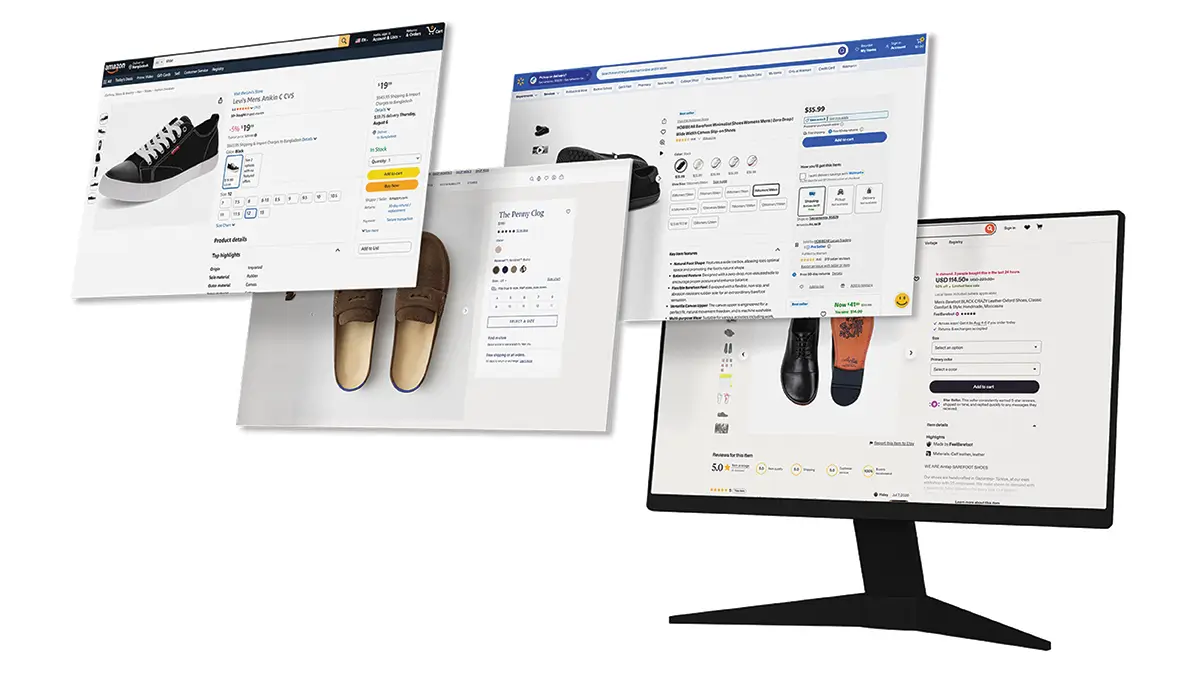
White colored background is at the core of marketing around eCommerce platforms. You’ve already noticed how the main images on product pages on Amazon and Shopify emphasize the product on clear backdrops.
You can take Walmart and Etsy pages as well, for instance, where you can easily get a clear view of shoe color and its build quality on white.
White background works so well for marketers that they use it to pinpoint the benefits of products in catalogs to potential customers. Additionally, there is rarely an alternative to white color on the back of the product for its detailed measurements.
What’s more, when it comes to overseeing their own internal inventory, product managers don’t want to have anything in the picture other than the product.
On-Foot vs White Background: Which One Works for Footwear Brands
It was never one-sided though, rather, brands’ strategies changed in different ways depending on the targeted audience and location. Let’s take a look at how shoe imagery has been for businesses across the industry in the real world.
Real World Case Scenario of On-Foot and White Background Shoe Images
| Shoe Businesses | On-Foot/White Background | Why |
| Renowned Sneaker Brands | On-Foot | To resonate with the emotions of loyal customers |
| Sports Shoes | On-Foot | Bringing confidence to performance |
| Formal Shoes | White Background | Meeting the design needs of elegant buyers |
| Casual Shoes | Mix
(On-Foot + White Background) |
Versatile intriguing points |
| Used Shoes | White Background | Building trust and getting aligned with platform compliance |
| Footwear Startups | White Background | Heavily focusing on marketplace compliance |
The table that instantly dictates who your customers are and what situation you’re in tells you what kind of images you should use.
Especially when eCommerce is all over the entire marketing horizon, you surely don’t want to stand against a white background with your newly started business, do you?
But things can take a different turn if you decide to run your business solely on social media. You don’t want to deal with the hassle of hundreds of policies on marketplaces.
TikTok or Pinterest, in fact, don’t put a fence around your product imagery. All you have to do is make the image as attractive as possible for the viewer.
Formula for Using Images Footwear Brands Can Follow in 2026
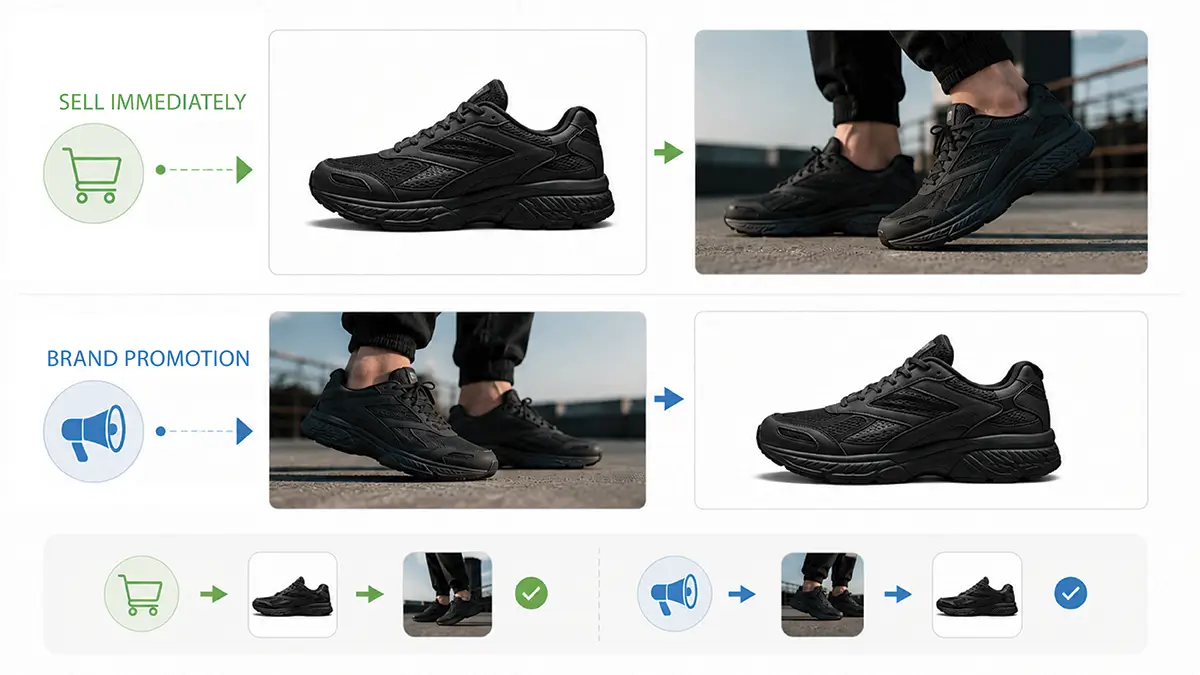
Whether you are brand new to the industry or part of an established ecosystem, there is one formula that has always worked in both situations:
| If your target is to sell immediately → first white background, then on-foot shots as attachments |
| If you want to build a brand through promotion → first on-foot, then white background |
Social media or email campaign, whatever you’re running, it is lifestyle photos that should be your main medium for attracting visitors. And through these, visitors will land on your product page, where the main image should have a white background.
How to Deal with AI White Background and Lifestyle Shoe Images
Besides generative AI, various types of tools have become so readily available that they are now one of the main means of creating image assets. The thing is that along with the benefits, they also bring problems.
AI Generated White Background Shoe Photo Problems
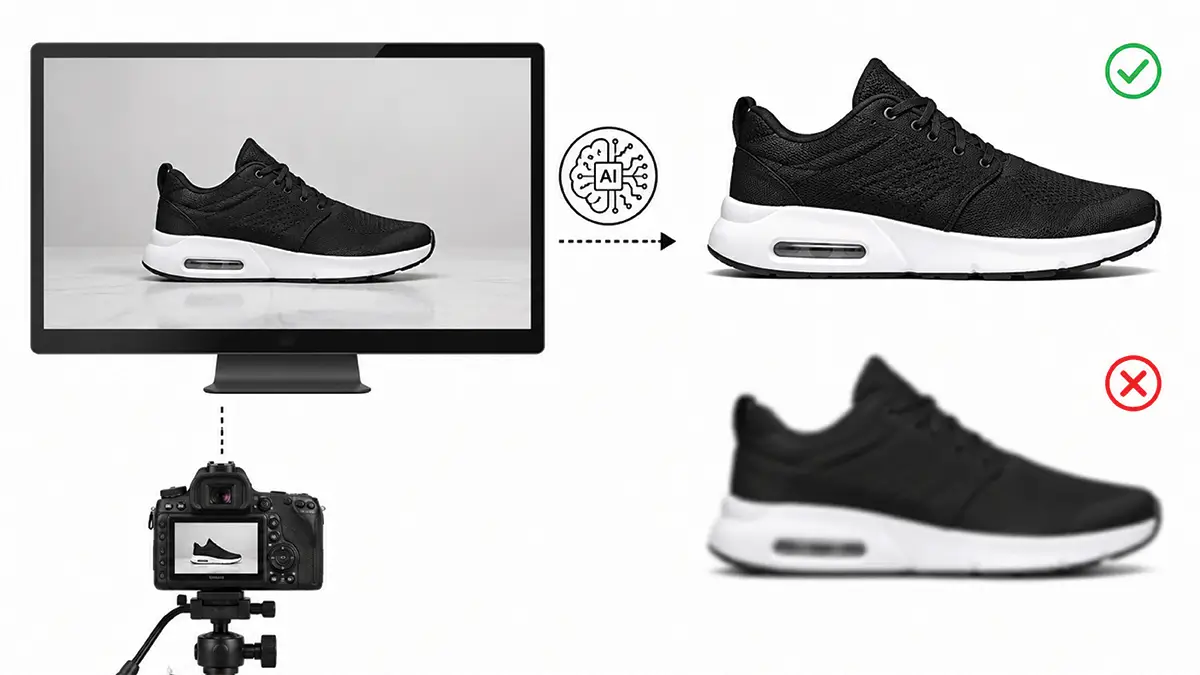
AI can create images with a white background if you let it do that from scratch, and it does so impressively. But the shoe photo that serves as the centerpiece of attention has many flaws.
When background removing in the case of a photo taken with a camera, most AI tools work so well that the empty space behind becomes neat. But the problem remains with quality.
| You may find the shoe image without a backdrop blurry or lose brightness significantly. |
AI Generated On-Foot Shoe Photo Problems
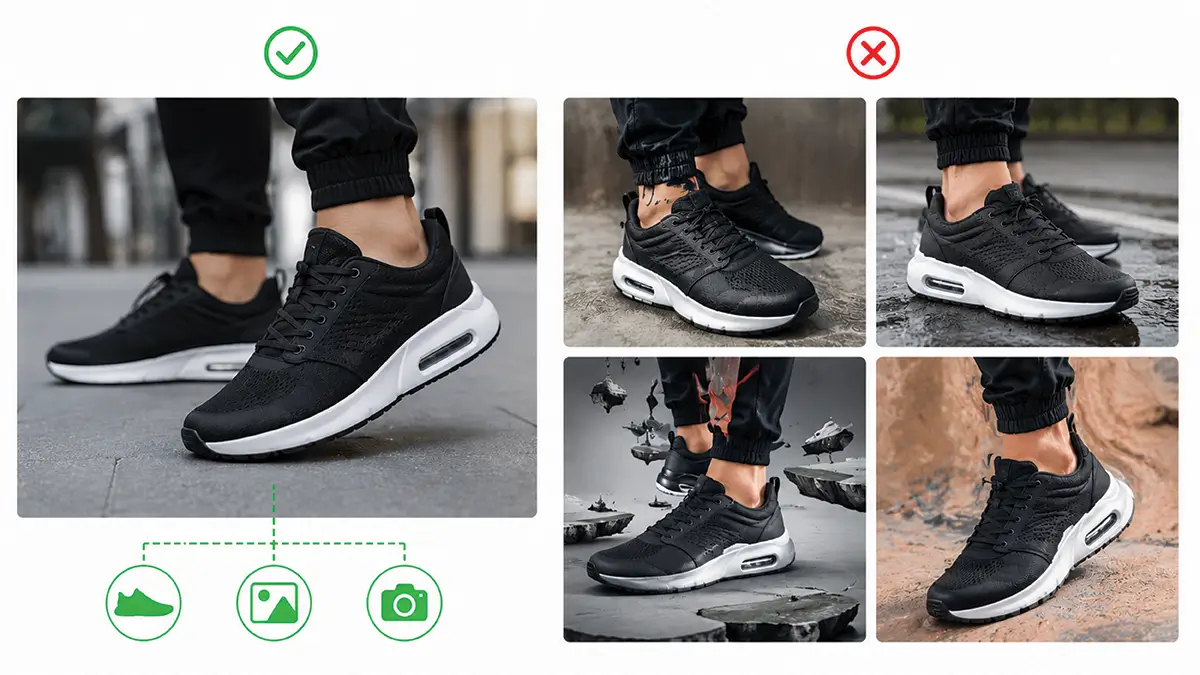
The AI-generated on-foot shoe images have a relatively high level of error, all credit goes to the detailing nature of the lifestyle images.
If the background is right, the shoe photo is not, and on the other hand, if you somehow get the shoe right, you find the area around it ruined.
The worst part is that even after you give a better prompt each time (you think you gave it properly this time), this cycle keeps going.
It’s really tiresome and time-consuming, the opposite of what you’ve been hearing about AI – it’ll give lots of images in no time. It actually does, though, yet those aren’t flawless.
What Are the Solutions
The way you can solve it is not to rely entirely on AI and turn to human shoe photo editors. You can feel free to use AI to generate images but remove the flaws manually.
Take photos of the actual shoes on the model’s feet up ahead of time to maintain the originality of the shoes and reduce the pressure of editing later.
You can leave the burden of lifestyle surrounding shots fully to AI. Then manually place the image of the actual shoe on that background.
And to get a white background, you can use tools like Photoroom’s AI background remover, which is quite effective at keeping the quality intact.
I’m not saying that there won’t be any minor errors at all after going through all of these, but it will greatly reduce the hassle and time compared to before.
Frequently Asked Questions About On-Foot vs White Background Shoe Images
1. Should I use an on-foot shoe photo as the main image in a Amazon product listing?
No, this is against Amazon’s rules. Your main image must have a white background behind your shoes. If you want to provide an on-foot shoe image as it is effective for visitor engagement, you can add it in the secondary section.
2. Is it possible to create on-foot images of shoes from the one with white background?
Yes, you can do this with AI. There are several recent AI tools like Leonardo or Adobe Firefly that you can use for this and the results they give are often close to quality.
3. On-foot or white background shots, which is better for meta ad campaigns on footwear products?
It’s on-foot images because it’s the kind of lifestyle image that people can relate to. These images give confidence in the shoe’s components and how the shoe will look when they walk in it.
4. Is it necessary for the model’s whole body to be in the photo for on-foot shoe images?
No, it only needs to be up to the ankle level. The most you can do if necessary is to include the lower part of the body.
5. How do I know which type of image is performing better?
You can check this by running A/B tests for eCommerce product page or advertisement whatever you’re going to do. Let’s say A has a white background image and B has an on-foot image. Now count how many views and add-to-cart clicks you get on each.
Verdict: Use Both for Steady Growth
There is really no room for leaning towards any one thing and abandoning the rest. That’s the point of this on-foot vs white background discussion.
You need to adopt both shoe image types if you want to achieve steady growth for your footwear brand in the long term. White color background is for selling in the marketplace and on-foot for branding to be precise.
The part of choosing criteria has been taken care of well, but how will you handle the editing hassle? This solution is also right there a click away from you.
Take Retouching Zone, a renowned name in the footwear industry that has been serving manual shoe editing for decades. Not sure if it’s a good idea to jump in?
You can try their service for free. See the results they can come up with, and then it’s time for you to decide.